Crochet Teal Lace Dress Pattern: Fitted Bodice, Openwork Sleeves, and Flared Skirt
Introduction A crocheted dress can be a showstopper, and this teal lace dress is designed to be exactly that. It pairs a fitted, solid-stitch...
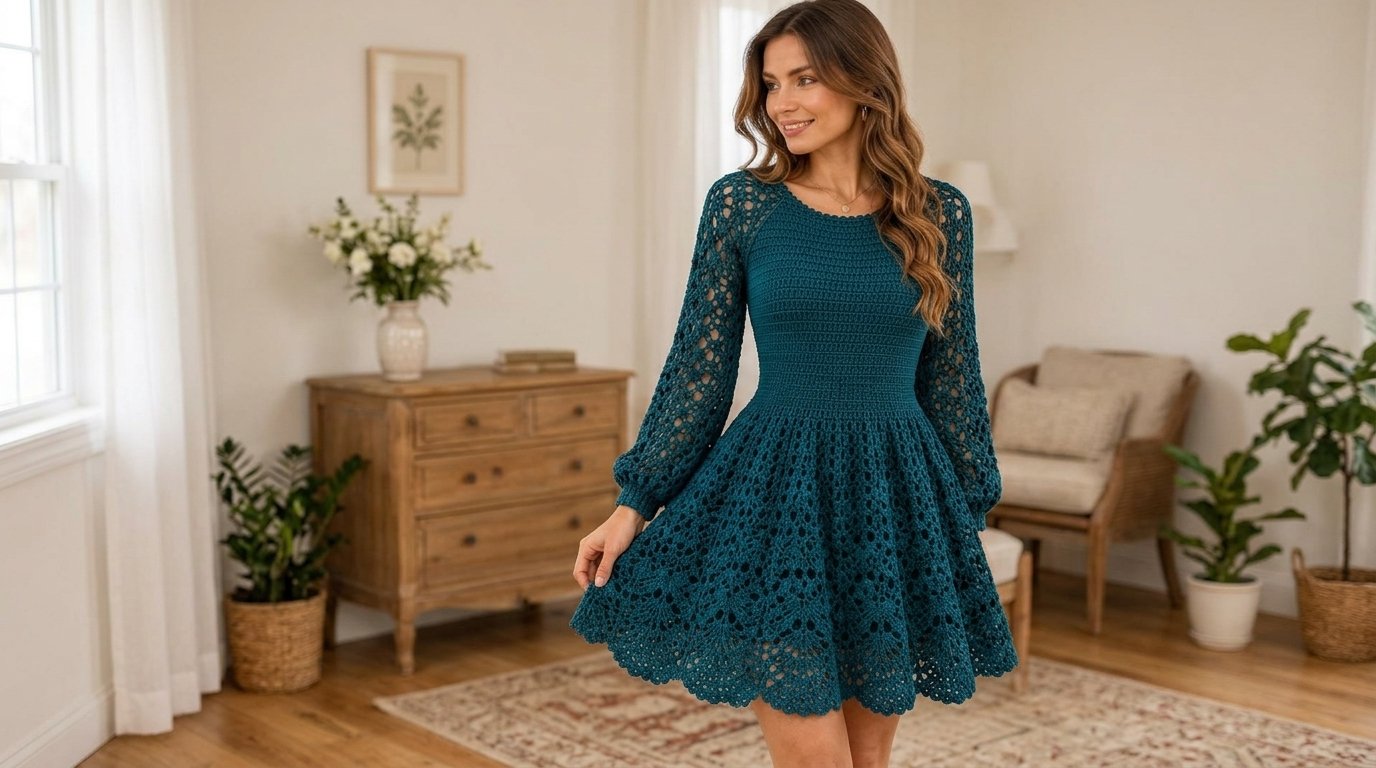
Introduction
A crocheted dress can be a showstopper, and this teal lace dress is designed to be exactly that. It pairs a fitted, solid-stitch bodice with long openwork sleeves and a flared, scalloped skirt. The result is a garment that looks elegant and modern, with the visual contrast between the dense bodice and the airy lace skirt doing most of the work.
This is an advanced pattern. It requires careful measuring, precise shaping to fit the body, and a solid understanding of how solid and lace stitches behave together. If you’re comfortable working garments, reading shaping instructions, and adjusting fit as you go, this dress is a satisfying project that produces a genuinely wearable result.
Why You’ll Love This Project
- A wearable garment. This is not a decorative piece; it’s a dress meant to be worn.
- Striking contrast. The fitted bodice and airy lace skirt create a beautiful silhouette.
- Detailed texture. Both solid and openwork lace stitches are used, so the dress stays visually interesting from start to finish.
- Customizable fit. The pattern includes guidance for adjusting the bodice and skirt to your measurements.
- A real challenge. If you’re looking to push your crochet skills into garment making, this project delivers.
Project Overview
- Project type: Crochet garment / dress
- Difficulty: Advanced
- Estimated time: About 40–60 hours, depending on size and pace
- Suggested finished size: Custom to your measurements; sample shown fits a standard medium (bust 36–38 inches, waist 28–30 inches, hip 38–40 inches)
- Yarn weight: Fingering or light sport (weight 1–2) cotton or cotton blend
- Crochet hook: 3.0 mm to 3.5 mm
- Main techniques: Working in rounds, shaping for bust and waist, working in rows for the skirt, openwork lace patterns, join-as-you-go skirt panel, and scalloped edging
- Construction: Bodice worked top-down or in panels, sleeves worked in rounds with shaping, skirt worked in panels or in rounds with increasing, and scalloped edge
- Terminology: US crochet terms
Sizes and times are estimates and will vary with your yarn, hook, and tension.
Materials and Supplies Needed
- Fingering or light sport-weight cotton or cotton-blend yarn in deep teal — about 1,200–1,600 yards depending on size
- 3.0 mm to 3.5 mm crochet hook
- Stitch markers
- Yarn needle
- Scissors
- Measuring tape
- (Optional) Removable stitch markers or safety pins for fitting
Choosing the Right Yarn and Hook
For a dress, yarn choice affects both drape and shape. A cotton or cotton blend is ideal because it holds its shape, drapes well, and shows the lace pattern clearly. A bamboo-cotton blend is another good option if you want more drape.
Fingering or light sport weight is recommended; heavier yarns will make the dress bulky and the lace less delicate. Use a hook that gives you a firm but flexible fabric. If the fabric feels too stiff to drape, go up a hook size. If the lace looks too open and the bodice too floppy, go down a size.
Gauge is critical for this project. Work a swatch in both the solid and lace stitch patterns and measure the number of stitches per inch. Compare it to the target gauge before starting; otherwise, the dress will not fit as intended.
Crochet Stitches and Abbreviations
- ch — chain
- sl st — slip stitch
- sc — single crochet
- hdc — half double crochet
- dc — double crochet
- tr — treble crochet
- st — stitch
- sts — stitches
- sp — space
- ch-sp — chain space
- inc — increase
- dec — decrease
Lace pattern notes: The lace sections are worked in a repeating pattern of chain spaces and clustered stitches. The exact lace stitch used in the sample is a combination of dc clusters separated by ch-2 or ch-3 spaces, arranged to form open, airy motifs.
Before You Start
Take accurate measurements. Measure bust, waist, hip, shoulder-to-shoulder, and desired skirt length. Write these down; you’ll refer to them often.
Work a swatch in both stitch patterns. Solid bodice stitches and lace skirt stitches behave differently. Check your gauge in both.
Choose your construction method. You can work the bodice top-down (easier for fitting) or in separate panels (easier for seaming). This pattern is written for top-down bodice and in-the-round skirt for simplicity.
Understand the lace repeat. The skirt lace has a stitch multiple; write down how many repeats you’ll need for your desired width.
Plan your color. A solid color like teal makes the texture stand out. Variegated yarn will hide the lace pattern.
Block as you go. Blocking the bodice before attaching the skirt can help you check the fit early.
Step-by-Step Crochet Instructions
The dress is built in three main sections: bodice, sleeves, and skirt.
Bodice
The bodice is worked top-down in joined rounds for a seamless fit.
Round 1: Ch a foundation chain to fit your chest measurement (with 1–2 inches of ease), join with a sl st to form a ring, and work sc in each ch. Mark the start of the round.
Rounds 2–6: Work sc in each st around, adding shaping at the bust and waist as needed. Increase or decrease as required to match your bust and waist measurements.
Rounds 7–12: Continue working sc or hdc around, maintaining a smooth fit. When you reach the waist, decrease to the waist measurement.
Neckline and armholes: At the top of the bodice, work a round of sc around the neckline, then a round of sl st to create a neat edge. For the armholes, leave a gap of the appropriate number of stitches, then work sc rounds along the opening to create a stable edge.
Sleeves
Sleeves are worked in rounds from the shoulder down.
Sleeve opening: Join yarn at the armhole opening. Work sc around the opening, distributing stitches evenly.
Sleeve body: Work the sleeve in rounds. Increase at regular intervals to reach the desired upper-arm width, then work straight rounds down the arm. Where the sleeve meets the wrist, decrease for a gentle fit, then work a picot or scalloped edge at the cuff.
Lace sleeve detail: Work openwork lace rounds into the sleeve, spacing the repeats around. Use the same lace repeat as the skirt to tie the design together.
Skirt
The skirt is worked in rounds from the waist down.
Round 1: Join yarn at the waist edge. Work a round of sc around, distributing stitches evenly and spacing increases so the first row of lace begins with the right multiple.
Rounds 2–? (lace rounds): Work the lace pattern in rounds. Every few rounds, increase by adding extra chain spaces or clusters so the skirt flares gradually. Continue until the skirt reaches your desired length.
Hem: Finish with a round of dc, then a round of scalloped edging (ch 3, sl st in next st, repeat) to create a soft scalloped hem.
Size Adjustments
- Bust fitting: Adjust the number of increase rounds in the bodice.
- Sleeve width: Change the number of straight rounds in the sleeves.
- Skirt length: Add or remove lace rounds.
- Skirt width: Change the number of increase rounds in the skirt.
Assembly and Finishing
Join sleeves to the bodice using a slip-stitch seam or whipstitch. Join the skirt to the bodice along the waist edge with a slip-stitch seam. Weave in all ends on the wrong side.
Blocking: Block the finished dress by pinning it to size, misting it with water, and letting it dry fully. Blocking helps the lace open up and the bodice hold its shape. It also evens out the fit.
Finishing details: Add a simple foundation row of sc around the neckline and sleeve cuffs to strengthen those edges, then finish with picot or scalloped edging.
Tips for Best Results
- Fit as you go. Try the bodice on before attaching the skirt so you can adjust before committing.
- Keep stitch counts consistent. Lace patterns need exact counts; if you’re off by one stitch, the next round will be off too.
- Use removable markers for fitting. They help you try the piece on without losing your place.
- Block each section. Blocking the bodice before attaching the skirt helps check the fit.
- Don’t skip the gauge swatch. It’s the most common reason garments don’t fit.
Common Mistakes and Troubleshooting
The dress doesn’t fit at the bust. The number of bodice increase rounds is likely off. Measure again and adjust.
The sleeves are too tight or too loose. Check the sleeve rounds for correct stitch counts and increase intervals.
The lace skirt looks uneven. Lace patterns need exact repeats; check that your stitch multiple is consistent across the round.
The scalloped hem looks wavy. Work the scalloped edge with even stitches. A sl st edge round before the scallop helps.
The dress stretches out of shape. The yarn may be too soft or the gauge too loose. Consider a denser cotton or a smaller hook.
Creative Variations
- Sleeveless version. Omit the sleeves and finish the armholes with a scalloped edge.
- Belted look. Add a simple crochet belt or a ribbon at the waist.
- Color-block bodice. Work the bodice in a complementary color to the skirt.
- A-line skirt. Increase more quickly in the skirt rounds for a wider flare.
- Tunic length. Shorten the skirt rounds for a long tunic.
How to Use or Style Your Crochet Project
This dress works for special occasions, weddings, and evening wear. Pair it with a slip underneath for modesty, since the lace skirt is openwork. Style it with strappy sandals or heels, or add a belt to define the waist.
Care and Maintenance
Hand wash in cool water with mild soap. Do not wring; roll in a towel to remove excess water. Lay flat to dry, reshaping the bodice and skirt as it dries. Store folded or on a padded hanger. Keep the dress away from direct sunlight and high heat. Always follow the yarn label’s care instructions.
Frequently Asked Questions
Can a beginner make this dress?
No. It’s an advanced garment pattern. It requires gauge control, fitting skills, and experience with shaping.
How much yarn does the dress use?
About 1,200–1,600 yards of fingering or light sport cotton, depending on size.
Do I need to wear a slip?
Yes, because the lace skirt is openwork. A slip in a matching or neutral color works well.
How do I make sure the dress fits?
Take accurate body measurements, swatch carefully, and try the bodice on before attaching the skirt.
Can I make the dress in a different color?
Yes. Any solid color works well.
How long does the dress take to make?
About 40–60 hours, depending on size and pace.
What if I get the gauge wrong?
If the gauge is off, the dress will not fit. Always swatch and adjust your hook or yarn before starting.
Conclusion
This teal lace dress is an ambitious project, but a rewarding one. The fitted bodice, openwork sleeves, and scalloped skirt combine into a wearable garment with real presence. It’s an advanced pattern that asks for patience, careful measurement, and attention to fit, and the result is a dress you’ll be proud to wear.
Related Crochet Projects
If you enjoy garment making, you might also like a crochet lace cardigan, a fitted crochet top with openwork sleeves, a crochet summer dress, or a crochet shawl.