Crochet Socks Pattern with Beautiful Pink Flowers
Introduction There is something special about slipping into a pair of soft, handmade crochet socks. This beautiful floral crochet socks pattern combines cozy texture,...
Introduction
There is something special about slipping into a pair of soft, handmade crochet socks. This beautiful floral crochet socks pattern combines cozy texture, delicate pink blossoms, and sage-green accents to create a charming accessory for relaxing at home.
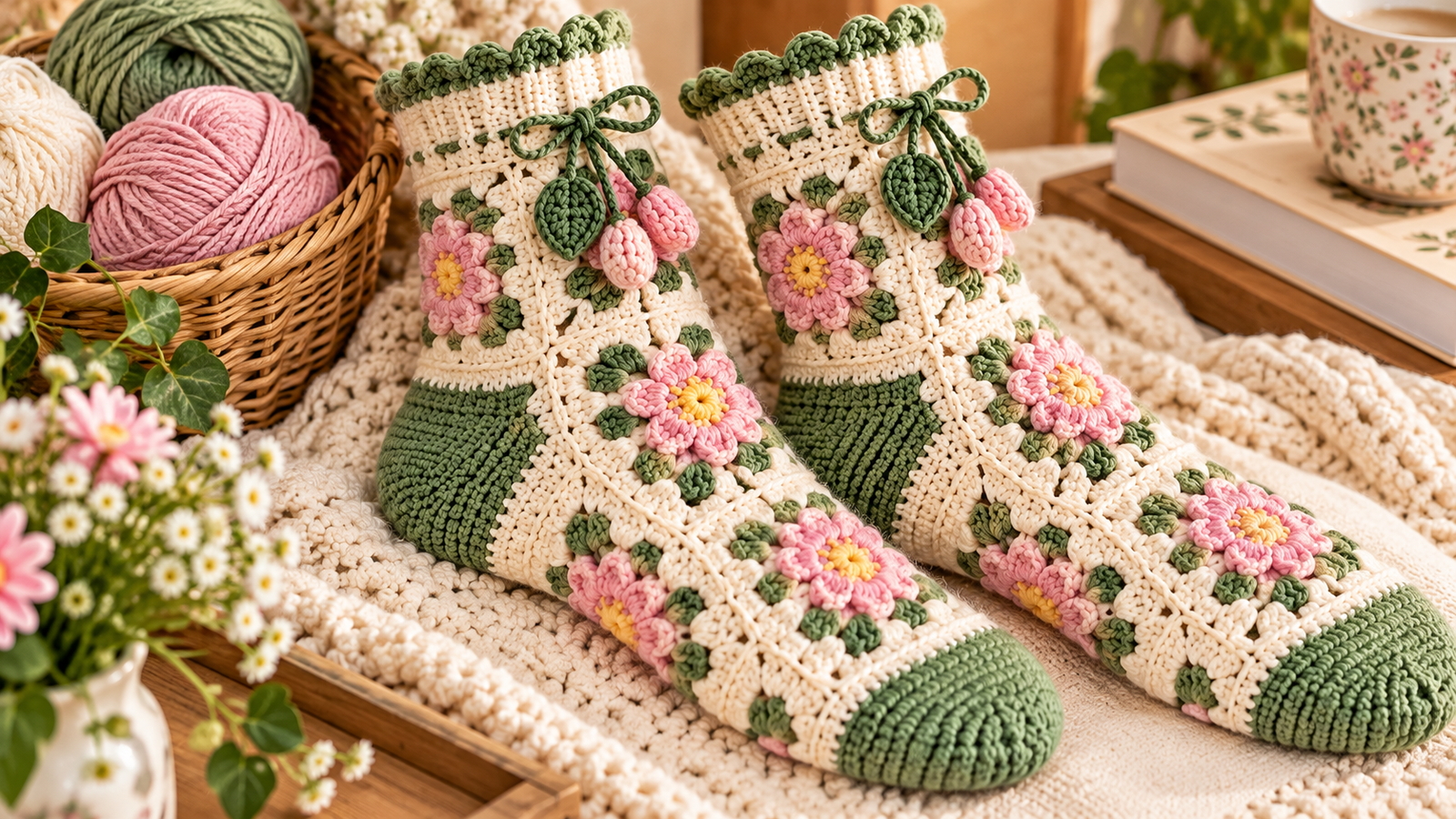
Inspired by romantic cottagecore fashion, these socks feature cream-colored crochet fabric, contrasting green toes and heels, decorative scalloped cuffs, and raised crochet flowers with little yellow centers.
The finished design has a comfortable, handmade appearance that pairs beautifully with pajamas, casual loungewear, and cozy weekend outfits.
This project is designed for crocheters who already know the basics and want to practice sock shaping, simple color changes, decorative edging, and flower appliqués.
The reference image is AI-generated. The instructions below are an original draft for a similar design and have not been physically tested. They provide a construction starting point rather than a guaranteed fit.
Why You’ll Love This Project
- Beautiful floral details: Raised pink flowers add a lovely handmade appearance.
- Cozy texture: Single crochet fabric creates a soft, substantial sock.
- Attractive color combination: Ivory, sage green, soft pink, and golden yellow work beautifully together.
- Useful crochet techniques: Learn toe shaping, heel construction, cuffs, and appliqués.
- Customizable fit: Adjust the foot length and circumference using measurements.
- Gift potential: Handmade slipper socks make thoughtful seasonal presents.
- Creative variations: Easily change the colors or simplify the flowers.
These socks are intended primarily for indoor lounging rather than wearing inside tight-fitting shoes.
Project Overview
| Feature | Details |
|---|---|
| Project | Floral crochet slipper socks |
| Skill level | Intermediate |
| Approximate time | 10–16 hours per pair |
| Sample size | Adult medium |
| Foot length | Adjustable |
| Yarn weight | DK / light worsted (#3) |
| Hook size | 3.5 mm |
| Construction | Toe-up with afterthought heel |
| Main stitches | Single crochet, increases, decreases |
| Cuff | Decorative scalloped edge |
| Terminology | US crochet terms |
The sample uses 48 stitches around the foot and assumes a working gauge of approximately 6 single crochet stitches per inch.
Materials and Supplies Needed
Prepare the following materials for one pair:
| Material | Estimated amount |
|---|---|
| Ivory DK yarn | 180–240 yards |
| Sage-green DK yarn | 70–100 yards |
| Soft pink DK yarn | 30–45 yards |
| Golden-yellow yarn | 10–15 yards |
| Dark green yarn for leaves | 20–30 yards |
| 3.5 mm crochet hook | 1 |
| Stitch markers | 3–4 |
| Yarn needle | 1 |
| Scissors | 1 pair |
| Waste yarn for heel opening | Small amount |
| Measuring tape | 1 |
Choose yarn that feels comfortable against the skin.
Choosing the Right Yarn and Hook
Soft DK-weight yarn is a useful choice for these socks. It provides enough structure for the flower decorations without making the fabric excessively thick.
A wool-acrylic blend or sock-appropriate washable yarn can provide warmth and a little resilience.
Cotton is another option, although cotton socks often stretch differently and may not recover their shape as readily.
Start with a 3.5 mm hook.
Gauge
Aim for approximately:
- 24 sc = 4 inches
- 26 rounds = 4 inches
This gives roughly 6 stitches and 6.5 rounds per inch.
Measure your actual gauge before determining the foot circumference.
For a 48-stitch sock, this gauge gives an unstretched circumference of approximately 8 inches.
The final fit depends on the yarn’s stretch and the wearer’s measurements.
Crochet Stitches and Abbreviations
| Abbreviation | Meaning |
|---|---|
| ch | Chain |
| sl st | Slip stitch |
| sc | Single crochet |
| hdc | Half double crochet |
| dc | Double crochet |
| inc | Increase: 2 sc in one stitch |
| dec | Single crochet decrease |
| BLO | Back loop only |
| st / sts | Stitch / stitches |
| rnd | Round |
| rep | Repeat |
| FO | Fasten off |
Special technique: Invisible decrease
Insert the hook through the front loops of the next two stitches, yarn over, pull through both loops, yarn over, and finish the single crochet.
This produces a neater decrease when shaping the heel and toe.
Before You Start
Measure the length and circumference of the foot.
For the sample, we will use a 48-stitch circumference and adjust the foot length as needed.
The socks are constructed from the toe upward.
Each sock includes a green toe, ivory foot, reserved heel opening, ivory ankle, green decorative cuff, and a separately worked green heel.
Crochet flowers are added after the main sock is finished.
Understanding the heel construction
The afterthought heel method leaves an opening in the sock that is completed later.
A contrasting piece of waste yarn temporarily holds the heel stitches.
After the foot and ankle are finished, the waste yarn is removed and the exposed stitches are used to crochet the heel.
This method avoids turning a traditional short-row heel.
Step-by-Step Crochet Instructions
Crocheting the sage-green toe
Begin with sage-green yarn.
Work in continuous rounds and use a stitch marker to indicate the beginning of each round.
Round 1: Make a magic ring and work 8 sc into it. (8 sts)
Round 2: Inc in every stitch. (16 sts)
Round 3: (Sc 1, inc) rep 8 times. (24 sts)
Round 4: (Sc 2, inc) rep 8 times. (32 sts)
Round 5: (Sc 3, inc) rep 8 times. (40 sts)
Round 6: (Sc 4, inc) rep 8 times. (48 sts)
Rounds 7–10: Sc around. (48 sts)
The toe should now form a rounded cup.
Crocheting the ivory foot
Change to ivory yarn.
Work one single crochet in each stitch around.
Continue in rounds until the sock reaches the location where the heel opening should begin.
For an approximately 9.5-inch finished foot, a useful starting estimate is to crochet until the toe-to-heel-opening length is about 7.5 inches, then check against the foot.
Because the heel adds depth when worn, measuring against the actual foot is more reliable than relying on a fixed number of rounds.
Creating the heel opening
Keep the stitch marker at the beginning of the round.
The first 24 stitches will form one side of the heel opening.
With contrasting waste yarn, work 24 sc.
Cut the waste yarn, leaving long ends.
Return to the beginning of these 24 stitches. Using the original ivory yarn, work 24 sc into the tops of the waste-yarn stitches, then continue working the remaining 24 stitches of the round.
The sock still has 48 working stitches.
The waste yarn can be removed later to expose the heel opening.
Crocheting the ankle
Continue working 48 sc around with ivory yarn.
Work approximately 20–26 rounds, or until the ankle reaches the desired height below the decorative cuff.
Try on the unfinished sock to check the fit.
A comfortable slipper sock should stay in place without feeling restrictive.
Making the scalloped green cuff
Change to sage-green yarn.
Round 1: Sc around. (48 sts)
Round 2: Sc around. (48 sts)
Round 3: Rep (skip 2 sts, work 5 dc in next st, skip 2 sts, sl st in next st) eight times.
Join and fasten off.
This creates eight decorative scallops around the upper edge.
Crocheting the heel
Carefully remove the contrasting waste yarn.
Place the exposed stitches onto your hook or secure them temporarily with a yarn needle.
You should have approximately 24 stitches along the upper edge and 24 along the lower edge.
Join sage-green yarn.
Work around the opening, picking up one stitch in each exposed stitch. Pick up an additional stitch at each side corner to reduce gaps if needed.
For this sample, aim to begin with 48 stitches, distributing any corner adjustments evenly.
Round 1: Sc around. (48 sts)
Round 2: Sc around. (48 sts)
For the following shaping rounds, identify the two side points of the heel.
Round 3: Decrease twice at each side, spaced symmetrically. (44 sts)
Round 4: Sc around. (44 sts)
Round 5: Repeat the four decreases. (40 sts)
Round 6: Sc around. (40 sts)
Continue alternating a decrease round with a plain round, reducing the stitch count by four on each decrease round.
Stop when 16 stitches remain.
Fasten off, leaving a long tail.
Flatten the opening and sew the remaining stitches together using a neat seam.
Weave in the ends securely.
Crocheting the pink flower appliqués
Use soft pink and golden-yellow yarn.
Round 1: With yellow yarn, make a magic ring and work 6 sc into the ring. Join. (6 sts)
Round 2: Change to pink yarn. In each stitch around, work (sl st, ch 2, 2 dc, ch 2, sl st).
Repeat in all six stitches to form six petals.
Fasten off, leaving a sewing tail.
Make approximately four to six flowers per sock.
Making small green leaves
With dark-green yarn, ch 6.
Starting in the second chain from the hook, work:
Sl st, sc, hdc, sc, sl st.
Fasten off, leaving a long tail.
Make two small leaves for each flower.
Attaching the flowers
Place flowers along the upper foot and outer ankle.
Avoid attaching bulky appliqués underneath the sole or directly over the heel.
Sew each flower securely through its center.
Arrange the green leaves around the flowers and attach them with small stitches.
Do not pull the fabric tightly while sewing.
Decorative ankle ties
For the decorative ties shown in the photograph, use sage-green yarn.
Ch approximately 70–90, depending on the desired length.
Sl st into each chain to create a firmer cord.
Thread the cord loosely through suitable stitches near the ankle opening.
Tie a small bow at the front.
Keep the cord decorative rather than relying on it to make an oversized sock fit. Avoid long dangling cords that could catch on objects.
Repeat for the second sock.
Assembly and Finishing
After crocheting both socks, compare their lengths and widths.
Check that the heels are positioned consistently and that the cuffs have the same number of scallops.
Weave in all yarn ends carefully.
Gently shape the toes and heels with your hands.
If the yarn label allows blocking, lightly dampen the socks and lay them flat to dry.
Avoid stretching the decorative flowers excessively.
Tips for Best Results
- Maintain consistent tension throughout the foot.
- Use stitch markers to track the beginning of rounds.
- Measure both feet before choosing a size.
- Check the fit before finishing the heel.
- Use smooth, soft yarn to prevent irritation.
- Attach flowers securely but avoid stiff, bulky seams.
- Keep the bottom of the sock free from decorations.
- Choose contrasting yarn colors that complement the ivory base.
Common Mistakes and Troubleshooting
The socks feel too tight
Your stitch gauge may be smaller than expected.
Use a larger hook or increase the stitch count while maintaining even increases around the toe.
The socks slip off
The ankle may be too loose.
Use a firmer cuff or reduce the ankle circumference carefully while preserving comfort.
The heel has holes
Pick up additional corner stitches where gaps appear, then decrease back to the intended stitch count.
The toe looks pointed
Make sure the increase stitches are distributed evenly.
The flowers curl excessively
Try a slightly larger hook or reduce your tension.
The sole feels uncomfortable
Avoid thick knots and loose ends inside the sock.
Keep decorative elements away from pressure points.
Creative Variations
Minimal botanical socks
Skip the flower appliqués and use only ivory and forest-green yarn.
Lavender cottagecore socks
Replace the pink flowers with lavender and the sage green with a deeper botanical shade.
Winter-inspired socks
Use burgundy flowers, evergreen toes, and warm cream yarn.
Short ankle socks
Reduce the ankle rounds and use a narrower decorative cuff.
Plain textured socks
Omit the decorative flowers and add simple color stripes around the upper ankle.
How to Use or Style Your Crochet Project
These floral socks are ideal for relaxing indoors.
Wear them with comfortable loungewear, rolled-up jeans, or cozy pajamas.
They also make lovely handmade gifts for birthdays, holidays, or special occasions.
The flowers give the socks a cottagecore appearance that works beautifully with soft neutral outfits.
Because crochet soles may be slippery on polished floors, consider adding a suitable nonslip treatment before wearing them around the home.
Avoid using these bulky socks inside tight shoes.
Care and Maintenance
Follow the care instructions on your chosen yarn label.
Handwashing is often a good option for socks with raised floral details.
Use cool water and mild detergent if appropriate for the fiber.
Gently squeeze out excess moisture without twisting the socks.
Lay flat to dry and reshape the flower appliqués while damp.
Store the socks folded in a dry place.
Check the decorative ties and appliqués periodically to make sure they remain secure.
Frequently Asked Questions
Are these crochet socks suitable for beginners?
They are best for confident beginners or intermediate crocheters because the heel shaping and fit adjustments require some experience.
Can I use acrylic yarn?
Yes, although yarn specifically suitable for socks may offer better resilience and durability.
How do I make the socks larger?
Increase the toe circumference in multiples that preserve the shaping pattern, then adjust the foot and ankle lengths.
Can I make them without flowers?
Absolutely. The basic sock construction works independently of the decorative appliqués.
Are crochet socks comfortable to wear?
They can be comfortable for indoor lounging when made with soft yarn and the correct fit.
How many flowers should I crochet?
Four to six flowers per sock creates a decorative look similar to the photograph. You can use fewer for a simpler design.
Can these socks be machine washed?
That depends on the yarn. Follow its care label and consider using a delicate wash bag if machine washing is permitted.
Has this crochet socks pattern been tested?
No. This is an original draft pattern inspired by an AI-generated design. The stitch counts have been planned for internal consistency, but fit and construction have not been physically tested.
Conclusion
This crochet socks pattern combines a cozy handmade construction with charming floral details.
The ivory fabric, sage-green toes and heels, and soft pink flower appliqués create a distinctive cottagecore look that feels warm and inviting.
Whether you choose the full floral design or a simpler variation, these crochet socks are a creative project for practicing toe-up construction, heel shaping, and decorative embellishments.