Crochet Flower Scarf Pattern: How to Make a Beautiful Floral Lace Scarf
A crochet flower scarf is the perfect combination of delicate lace, colorful blossoms, and handmade charm. With its airy cream mesh, pastel crochet flowers,...
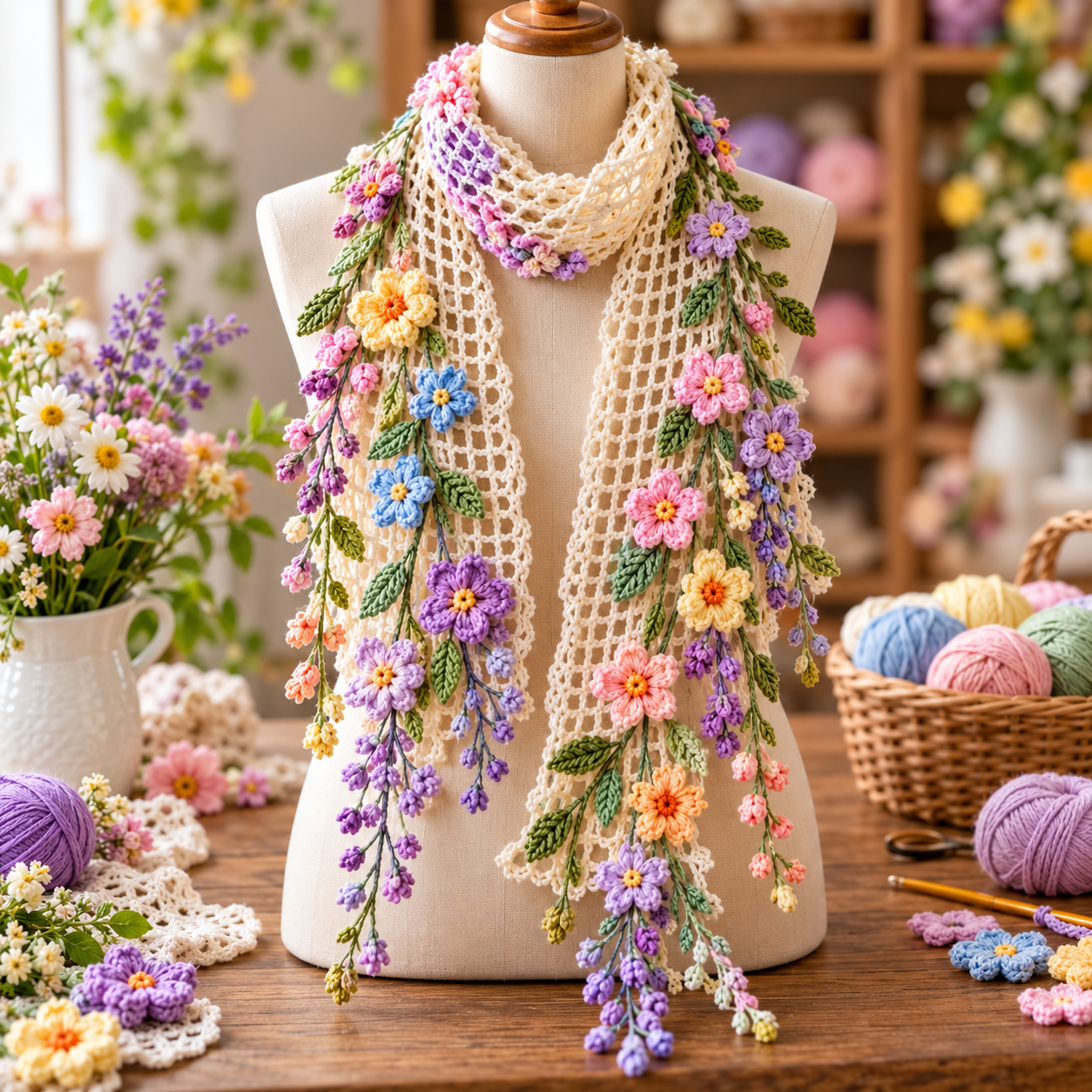
A crochet flower scarf is the perfect combination of delicate lace, colorful blossoms, and handmade charm. With its airy cream mesh, pastel crochet flowers, cascading vines, and tiny green leaves, this romantic floral scarf brings a beautiful cottagecore-inspired touch to any outfit.
Whether you’re looking for a lightweight spring accessory, a thoughtful handmade gift, or a creative way to practice crochet flowers, this project offers plenty of opportunities to experiment with colors, textures, and floral arrangements.
In this step-by-step tutorial, you’ll learn how to crochet an openwork mesh scarf, create different flower motifs, make delicate leaves and hanging buds, and attach everything to form a gorgeous floral accessory.
Skill level: Intermediate · US crochet terms · Estimated time: 12–20 hours
Pattern note: This is an original, untested pattern inspired by the provided photograph, not an exact reconstruction. The stitch counts and motif placements are suggested and may need adjustment to achieve the desired look.
Why You’ll Love This Crochet Flower Scarf
This scarf stands out because of its soft, flowing structure and three-dimensional floral decorations. Unlike traditional winter scarves, the open mesh allows the fabric to drape beautifully without feeling heavy.
The combination of lavender, pink, blue, yellow, and green creates a whimsical garden effect, while the cream background helps every handmade flower stand out.
You’ll especially love this project because:
- The lightweight mesh is comfortable for spring and mild weather.
- Each flower can be customized with different colors and sizes.
- The hanging floral vines add movement and texture.
- The modular construction makes it easy to decorate gradually.
- It’s a lovely handmade accessory for weddings, festivals, and everyday outfits.
Materials and Supplies
For a scarf approximately 8 inches wide and 65 inches long, gather the following supplies.
| Material | Recommended amount |
|---|---|
| Cream cotton or cotton-blend yarn, DK/light worsted | 250–350 yards |
| Pastel yarn for flowers, DK weight | 20–40 yards per color |
| Green yarn for leaves and stems | 80–120 yards |
| Crochet hook | 3.5 mm or 4 mm |
| Tapestry needle | 1 |
| Scissors | 1 pair |
| Stitch markers | Optional |
| Measuring tape | 1 |
Choose soft, lightweight yarn that provides enough stitch definition to highlight the lace pattern. Cotton blends are particularly suitable because they maintain the shape of the flowers while allowing the scarf to drape naturally.
Crochet Abbreviations (US Terms)
| Abbreviation | Meaning |
|---|---|
| ch | Chain |
| sc | Single crochet |
| hdc | Half double crochet |
| dc | Double crochet |
| tr | Treble crochet |
| sl st | Slip stitch |
| st(s) | Stitch(es) |
| sp | Space |
| rep | Repeat |
| FO | Fasten off |
Step 1: Crochet the Open Mesh Scarf Base
The foundation of this floral scarf is a simple, airy mesh pattern. This creates the lightweight texture visible beneath the decorative flowers.
Foundation chain
Using cream yarn and a 4 mm crochet hook:
- Make a slip knot.
- Chain 43 stitches.
- Work 1 dc into the seventh chain from the hook.
- Chain 3, skip the next 3 chains, and work 1 dc into the following chain.
- Repeat across the foundation chain.
You should have 10 open mesh spaces across the width.
Row 2
- Chain 6 and turn. This counts as 1 dc and ch-3.
- Skip the first mesh space.
- Work 1 dc into the next dc.
- Chain 3 and work 1 dc into the following dc.
- Repeat across the row, ending with 1 dc in the third chain of the previous turning chain.
Repeat the mesh pattern
Continue repeating Row 2 until the scarf measures approximately 65 inches long, or your preferred length.
Fasten off and weave in the yarn ends.
Crochet tip: Keep your chain stitches relaxed. If the mesh feels tight or curls inward, use a slightly larger hook.
Step 2: Crochet the Lavender Five-Petal Flowers
The lavender flowers are among the most eye-catching details in the scarf. Their rounded petals and contrasting yellow centers create a cheerful, dimensional appearance.
Flower center
Using yellow yarn:
- Make a magic ring.
- Work 10 sc into the ring.
- Pull the ring closed.
- Join with a sl st to the first sc.
- Fasten off.
Create the petals
Join lavender yarn into any stitch.
- Chain 2.
- Work 3 dc into the same stitch.
- Chain 2 and sl st into the same stitch.
- Sl st into the next stitch.
- Repeat the petal sequence in that stitch.
- Continue until you have 5 petals, using two center stitches per petal.
Fasten off, leaving a long tail for attaching the flower to the scarf.
For a fuller flower, replace the 3 dc in each petal with 4 dc.
Make approximately 8–12 lavender flowers in different sizes.
Step 3: Crochet the Pink Flowers
The pink flowers add softness and balance to the brighter lavender and yellow blooms.
Using light pink yarn:
- Create a magic ring.
- Work 10 sc into the ring and join.
- Chain 2 and work 1 hdc, 2 dc, and 1 hdc into the same stitch.
- Chain 2 and sl st into the same stitch.
- Sl st into the next stitch.
- Repeat until 5 petals are completed.
Add a small yellow center using a few embroidery stitches or a tiny crocheted circle.
Make 6–10 pink flowers.
You can also use darker pink yarn for selected flowers to create a more natural garden-inspired appearance.
Step 4: Crochet the Yellow and Blue Flowers
For visual variety, create a few yellow and blue blossoms using the same five-petal construction.
Yellow flowers
Use soft butter-yellow yarn for the petals and golden-orange yarn for the center. Make approximately 4–6 flowers.
Blue flowers
Use pastel blue yarn with yellow centers. Make approximately 4–6 flowers.
Vary the petal height by using hdc for smaller blossoms and dc or tr for larger blossoms.
This combination of flower sizes will help the scarf look more organic instead of perfectly uniform.
Step 5: Crochet the Green Leaves
The small green leaves provide a natural finishing touch and connect the flowers into flowing botanical arrangements.
Basic crochet leaf pattern
Using green yarn:
- Chain 9.
- Work 1 sc into the second chain from the hook.
- Work 1 hdc into the next chain.
- Work 1 dc into each of the next 3 chains.
- Work 1 hdc into the next chain.
- Work 1 sc into the next chain.
- Work 3 sc into the final chain to turn around the tip.
- Continue along the opposite side of the foundation chain, working 1 sc, 1 hdc, 3 dc, 1 hdc, and 1 sc into the corresponding chains.
- Join with a sl st.
Fasten off, leaving a yarn tail.
For more pointed leaves, work a picot at the tip using ch 2 and sl st into the first chain.
Make approximately 20–30 leaves in different shades of green.
Step 6: Crochet the Hanging Flower Buds
One of the most distinctive features of this scarf is the collection of small buds cascading from thin green stems.
These delicate details give the accessory a whimsical, almost fairy-garden appearance.
Small flower bud pattern
Using lavender, pink, or peach yarn:
- Make a magic ring.
- Work 6 sc into the ring.
- Work 2 sc into each stitch around (12 stitches).
- Work 1 sc into each stitch for 2 rounds.
- Work sc2tog six times (6 stitches).
- Lightly shape the bud with your fingers.
- Fasten off, leaving a tail for attaching.
Make approximately 20–35 buds in assorted pastel colors.
Create the stems
Using green yarn, chain between 15 and 40 stitches, depending on the desired length.
Slip stitch back along the chain to create a slightly firmer stem.
Attach a flower bud at the end and add one or two leaves along the length.
Create stems of different lengths for a more natural appearance.
Step 7: Arrange the Flowers and Vines
Before sewing anything into place, lay your finished scarf flat on a clean surface.
Position the larger flowers first, concentrating them near the ends and outer edges. Then fill the spaces with smaller flowers, leaves, and hanging buds.
For a balanced arrangement:
- Place lavender flowers along both ends of the scarf.
- Add pink blossoms near the upper and middle sections.
- Distribute yellow and blue flowers between the larger blossoms.
- Allow some vines to extend beyond the scarf’s edges.
- Leave portions of the cream mesh visible to preserve its airy texture.
Avoid placing every flower in a straight line. Slightly irregular spacing will create a more realistic floral arrangement.
Step 8: Attach the Flowers to the Scarf
Thread a tapestry needle with the long yarn tail from each flower.
- Position the flower over the desired mesh intersection.
- Sew through the back of the flower and around a sturdy mesh stitch.
- Repeat several times to secure the flower.
- Knot the yarn discreetly on the reverse side.
- Weave in the remaining ends.
Attach the leaves and vines using the same method.
For longer hanging stems, anchor them at two or three points along the scarf so they stay in place while the lower sections hang freely.
Important: Secure each decoration firmly enough for normal wear, but avoid pulling the mesh stitches too tightly. The scarf should remain soft and flexible.
Step 9: Add the Final Floral Details
Once the main flowers are attached, evaluate the overall arrangement.
Add a few small blossoms to any areas that look empty, or attach extra leaves to balance the green accents.
You can also introduce additional details such as:
- Tiny crochet daisies.
- Miniature purple flower clusters.
- Peach-colored hanging buds.
- Twisting green vines.
- Layered flowers with contrasting centers.
The goal is to create a scarf that resembles a blooming garden while maintaining a lightweight and wearable structure.
Step 10: Block and Finish the Crochet Scarf
Blocking helps the mesh open evenly and gives the scarf a polished appearance.
- Check that all yarn ends are securely woven in.
- Lightly dampen the scarf with water if suitable for your yarn.
- Lay it flat on a blocking mat or clean towel.
- Gently stretch the mesh to the desired shape.
- Arrange the flowers and leaves with your fingers.
- Allow the scarf to dry completely.
Follow the yarn manufacturer’s care instructions, especially if using wool, acrylic, or delicate blended fibers.
Avoid pressing an iron directly onto the three-dimensional flowers, as this can flatten their petals.
Crochet Flower Scarf Size and Customization
This pattern is easy to adapt for different styles and occasions.
| Scarf style | Suggested measurements |
|---|---|
| Short decorative scarf | 6 × 45 inches |
| Standard floral scarf | 8 × 65 inches |
| Long statement scarf | 9 × 75 inches |
| Wide floral wrap | 16 × 70 inches |
To change the width, adjust the foundation chain in multiples of 4, plus 3 additional chains. To change the length, simply work more or fewer mesh rows.
For a minimalist design, use only two flower colors. For a romantic cottagecore look, combine several pastel shades with sage and olive green leaves.
Tips for Making Your Crochet Flower Scarf Look Professional
A few small details can make a significant difference in the finished project.
Use consistent yarn weights. Flowers made from yarns of dramatically different thicknesses can look uneven. Keep the main yarn weights similar unless you intentionally want contrasting textures.
Vary the flower sizes. A mixture of small, medium, and large blossoms creates depth and makes the arrangement more interesting.
Balance the colors. Distribute your brightest flowers throughout the scarf instead of concentrating them in one area.
Secure the decorations carefully. Flowers and leaves should withstand gentle handling without pulling away from the mesh.
Check the drape regularly. Hang the scarf over a dress form or your shoulders during assembly to see how the vines fall.
Common Crochet Mistakes to Avoid
Making the mesh too tight
Tight chains can prevent the scarf from draping naturally. Keep your tension even and use a larger hook if necessary.
Adding too many heavy flowers
A large number of thick flowers can stretch the mesh. Choose lightweight yarn and distribute the decorations evenly.
Making all the vines the same length
Identical vine lengths can make the arrangement appear stiff. Mix short and long stems to create a more organic design.
Forgetting to secure the flower centers
Make sure the center of each flower is firmly attached, particularly if the scarf will be worn frequently.
Frequently Asked Questions
Is this crochet flower scarf beginner-friendly?
The mesh base is relatively simple and suitable for adventurous beginners. The decorative flowers, leaves, and assembly require a little more practice, making the complete project best suited to intermediate crocheters.
What yarn works best for a crochet floral scarf?
DK-weight cotton or cotton-blend yarn is a good option. It offers stitch definition, softness, and enough structure for the flower motifs.
How long does it take to crochet this scarf?
Plan for approximately 12–20 hours, depending on your crochet speed, scarf length, and the number of decorative flowers you choose to make.
Can I wash a crochet flower scarf?
Yes, if your yarn is washable. Gentle hand washing in cool water is generally a good approach for delicate crochet decorations. Lay the scarf flat to dry and reshape the flowers while damp.
Can I make this scarf without the hanging vines?
Absolutely. You can decorate the mesh with flat crochet flowers only, creating a simpler and more practical accessory for everyday wear.
Final Thoughts
A handmade crochet flower scarf is more than a simple accessory. It’s a creative project that combines delicate lacework, colorful floral motifs, and beautiful botanical details into one unique design.
From the lightweight cream mesh to the cascading lavender blossoms and pastel flowers, every element adds texture, movement, and personality.
Whether you choose to recreate the romantic garden-inspired color palette or experiment with your own favorite shades, this crochet floral scarf is a wonderful opportunity to develop your crochet skills and create something truly personal.
Save this crochet flower scarf pattern for your next handmade project, and enjoy bringing your own little garden of yarn flowers to life!