Crochet Daffodil Flowers Pattern: Beautiful Spring Bouquet
Spring flowers have a special way of making a room feel brighter, and daffodils are among the most recognizable signs of the season. With...
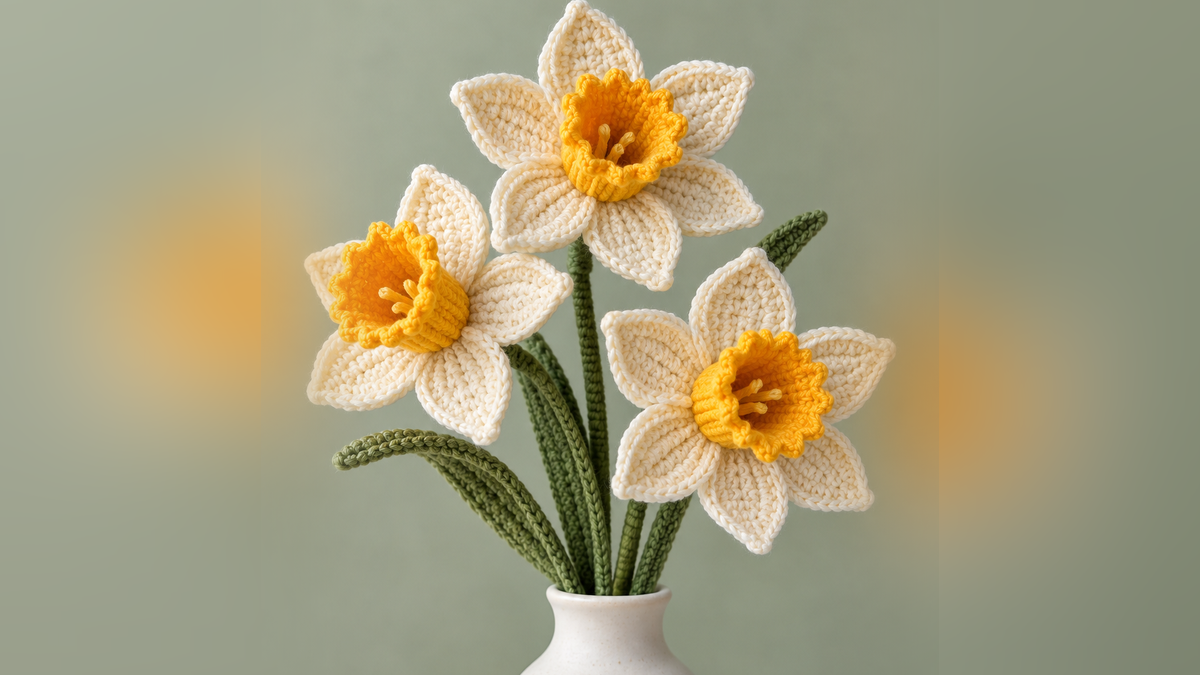
Spring flowers have a special way of making a room feel brighter, and daffodils are among the most recognizable signs of the season. With their delicate petals, cheerful trumpet-shaped centers, and elegant green leaves, these flowers are a lovely inspiration for crochet projects.
This crochet daffodil flowers pattern is inspired by a charming arrangement of three handmade-style daffodils. Each flower features six creamy ivory petals surrounding a golden-yellow center, with slender green stems and elongated leaves. Displayed together in a simple ceramic vase, they create a beautiful spring decoration that never wilts.
The project uses familiar crochet stitches and straightforward shaping techniques. Although the individual stitches are beginner-friendly, assembling the shaped petals, raised centers, and supported stems requires some patience.
In this tutorial, you’ll learn how to crochet the petals, form the distinctive daffodil trumpet, create leaves, and assemble the flowers into a decorative bouquet.
Pattern note: This is an original, AI-inspired crochet design with draft instructions. The stitch counts have been checked for internal consistency, but the pattern has not been physically tested. Finished appearance and dimensions may vary with yarn, tension, and assembly.
Why You’ll Love This Crochet Daffodil Project
Crochet daffodils combine the cheerful appearance of real spring flowers with the lasting charm of handmade decorations.
One of the most appealing features is their distinctive shape. Unlike a simple flat crochet flower, a daffodil has a raised trumpet center surrounded by separate petals. This gives the finished flower a dimensional, recognizable silhouette.
You’ll also enjoy several practical benefits:
- Long-lasting decoration: Crochet flowers maintain their appearance without watering or sunlight.
- Beautiful spring colors: Ivory, golden yellow, and olive green create a fresh, natural combination.
- Customizable design: Change the petal colors or trumpet size to make different daffodil varieties.
- Thoughtful handmade gift: A small bouquet makes a lovely present for birthdays, Mother’s Day, or spring celebrations.
- Reusable decor: Display the flowers year after year.
- Manageable components: Work on individual petals, centers, and leaves before assembling the bouquet.
The individual flower is portable enough to crochet in short crafting sessions, making it an enjoyable project to work on over several days.
Crochet Daffodil Project Overview
| Project detail | Description |
|---|---|
| Project | Three-stem crochet daffodil bouquet |
| Skill level | Confident beginner to intermediate |
| Estimated time | 5–8 hours for three flowers |
| Finished flower diameter | Approximately 4–5 inches |
| Finished stem length | Approximately 10–12 inches |
| Yarn weight | Light worsted/DK, weight 3 |
| Crochet hook | 3.0 mm |
| Main stitches | Chain, slip stitch, single crochet, half double crochet, double crochet |
| Construction | Individual petals, trumpet centers, leaves, and wrapped stems |
| Terminology | US crochet terms |
These measurements and completion times are estimates. Your results will depend on yarn thickness, stitch tension, and how you shape the finished flowers.
The bouquet consists of three daffodils, each with six separate petals and one trumpet center. The flowers are supported by wrapped floral stems, accompanied by narrow crocheted leaves.
Materials and Supplies Needed
Gather all your supplies before starting so you can work on the individual pieces without interruptions.
Yarn
Use light worsted or DK cotton yarn in the following colors:
| Color | Estimated amount | Purpose |
|---|---|---|
| Warm ivory | 70–100 yards | Daffodil petals |
| Golden yellow | 35–50 yards | Trumpet centers |
| Olive green | 55–80 yards | Leaves and stems |
| Pale yellow | 2–5 yards | Optional decorative stamens |
These estimates are for a bouquet of three flowers and several leaves. Actual yarn usage may differ.
Crochet Tools and Accessories
- 3.0 mm crochet hook
- Yarn needle
- Sharp scissors
- Stitch markers
- Flexible floral wire or craft stems
- Floral tape
- Wire cutters
- Small amount of fiberfill, if needed for shaping
- White ceramic vase or another decorative container
- Optional fabric-safe craft adhesive
Safety note: Floral wire may have sharp ends. Fold or cover exposed ends carefully. This bouquet is decorative and should be kept away from small children and pets who might pull apart or swallow its components.
Choosing the Right Yarn and Crochet Hook
Choosing suitable yarn is important for making crochet daffodils that hold their shape.
Best Yarn for Crochet Daffodils
Cotton yarn is an excellent option because it provides clear stitch definition and tends to produce a structured fabric.
The slight firmness of cotton helps the petals maintain their shape without making them excessively bulky.
For this particular bouquet, choose:
- Ivory cotton for soft, natural-looking petals.
- Golden-yellow cotton for the bright trumpet centers.
- Olive-green cotton for stems and leaves.
Avoid very fuzzy yarn for your first attempt. Smooth yarn makes it easier to see stitch placement and correct mistakes.
Choosing Your Hook
A 3.0 mm hook is a practical starting point for DK cotton yarn.
Using a slightly smaller hook than the yarn label might suggest can create a firmer fabric, which is helpful for decorative flowers.
However, your stitches should remain comfortable to work into. If the fabric becomes too stiff or difficult to crochet, increase your hook size slightly.
Can You Use Acrylic Yarn?
Yes. Acrylic yarn can work for crochet daffodils, especially if you already have suitable colors available.
However, acrylic may produce softer petals that need additional shaping.
If you substitute yarn, make a single sample petal before completing the entire bouquet.
Crochet Stitches and Abbreviations
This pattern uses US crochet terminology.
| Abbreviation | Meaning |
|---|---|
| ch | Chain |
| sl st | Slip stitch |
| sc | Single crochet |
| hdc | Half double crochet |
| dc | Double crochet |
| st / sts | Stitch / stitches |
| inc | Two single crochets in one stitch |
| BLO | Back loop only |
| FO | Fasten off |
Basic Stitch Explanations
Chain (ch): Yarn over and pull through the loop on your hook. Repeat to create the required number of chains.
Slip stitch (sl st): Insert the hook into the specified stitch, yarn over, and pull through the stitch and the loop on your hook.
Single crochet (sc): Insert the hook, yarn over, and pull up a loop. Yarn over again and pull through both loops.
Half double crochet (hdc): Yarn over, insert the hook, and pull up a loop. Yarn over and pull through all three loops.
Double crochet (dc): Yarn over, insert the hook, and pull up a loop. Yarn over and pull through two loops, then yarn over and pull through the remaining two.
Increase (inc): Work two single crochet stitches into the same stitch.
You’ll also work stitches on both sides of a foundation chain to create elongated petal and leaf shapes.
Before You Start
A little preparation makes the construction process much easier.
Understand the Flower Structure
Each daffodil has three primary components:
- Six separate pointed petals.
- One raised trumpet-shaped center.
- A supported green stem with narrow leaves.
The petals sit around the base of the trumpet, creating the familiar daffodil silhouette.
Check Your Tension
Crochet a small sample using your ivory yarn.
If your stitches appear loose or large gaps form between them, try a smaller crochet hook.
Aim for fabric that feels firm enough to hold a petal shape while remaining flexible enough to arrange naturally.
Prepare the Assembly Materials
Cut three stem supports to your desired length, allowing some extra length for attachment to the flower heads.
Prepare the supports with covered ends so that sharp wire cannot poke through the crochet fabric.
The green yarn will be used to cover or decorate these supports during assembly.
Plan Your Bouquet
To imitate a natural daffodil arrangement, position one flower slightly higher than the other two.
This creates visual balance without making the bouquet overly symmetrical.
Step-by-Step Crochet Daffodil Instructions
The following instructions make one six-petal flower with a raised trumpet center. Repeat the flower components three times for the complete bouquet.
How to Crochet the Daffodil Petals
Use ivory DK cotton yarn and a 3.0 mm hook.
You will make six separate petals for each flower.
Each petal is worked around both sides of a starting chain, creating a narrow, pointed oval.
Petal foundation
Ch 11.
Petal Round 1
Starting in the second chain from your hook:
- Sc in the next 2 chains.
- Hdc in the next 2 chains.
- Dc in the next 4 chains.
- Hdc in the next chain.
- Work 3 sc in the last chain to turn around the tip.
- Continue along the opposite side of the foundation chain.
- Hdc in the next chain.
- Dc in the next 4 chains.
- Hdc in the next 2 chains.
- Sc in the final 2 chains.
Join with a sl st to the first sc.
You should have 23 stitches around the petal.
The extra stitches at the far end create a gently rounded tip, while the narrower base will attach to the trumpet.
Petal Round 2
Work one sc into each of the 23 stitches around the petal.
Join with a sl st.
FO, leaving a yarn tail approximately 8 inches long for assembly.
Shape the Petal
Lay the petal on a flat surface.
Gently pinch the tip into a slightly pointed shape, then stretch the sides outward to create an elongated oval.
You can lightly dampen the petal and pin it into position while drying if your yarn’s care instructions allow wet blocking.
Make six petals for one flower.
For a bouquet of three daffodils, you will need 18 petals.
How to Crochet the Yellow Trumpet Center
The daffodil trumpet is the most distinctive feature of this project.
It forms a small cylindrical cup with a slightly ruffled outer edge.
Use golden-yellow yarn.
Foundation Round
Ch 18 and join with a sl st to form a ring, being careful not to twist the chain.
Round 1
Ch 1, sc in each chain around.
Join with a sl st.
Stitch count: 18 sc.
Round 2
Ch 1, sc in BLO of each stitch around.
Join with a sl st.
Stitch count: 18 sc.
Working into the back loops helps the trumpet begin to stand upright.
Rounds 3–5
Ch 1, sc in each stitch around.
Join with a sl st.
Stitch count: 18 sc per round.
The piece should now resemble a short tube.
Round 6
Ch 1, repeat 2 sc in the next stitch, 1 sc in the next stitch around.
Join with a sl st.
Stitch count: 27 sc.
Round 7: Decorative Ruffle
Repeat sl st in the next stitch, 3 hdc in the next stitch, sl st in the next stitch around.
Because there are 27 stitches, this creates nine small scallops.
Join with a sl st and FO.
Leave a long tail for assembly.
Add Optional Yarn Stamens
For a more detailed flower, you can add simple yarn stamens inside the trumpet.
Cut two or three short strands of pale-yellow yarn.
Fold each strand in half and tie a small knot near the folded end.
Secure the loose ends at the lower interior of the trumpet, allowing the knotted portions to extend slightly into the cup.
Trim them so they remain shorter than the trumpet’s rim.
These details are decorative rather than structural, so you can omit them for a simpler version.
Assemble the Six Petals
Arrange the six ivory petals around the base of the yellow trumpet.
Position the petals evenly, allowing the narrow ends to overlap slightly beneath the cup.
Use the long yarn tails to sew each petal securely around the lower edge of the trumpet.
Work through the petal base and the lower trumpet stitches rather than through the delicate ruffled rim.
Once all six petals are attached, inspect the flower from the front.
Adjust the petal spacing so the flower appears balanced.
The yellow trumpet should sit slightly forward of the ivory petals.
Make the Green Stem
Use a covered floral support approximately 10–12 inches long.
Begin with a securely folded or capped upper end.
Attach olive-green yarn near the top.
Wrap the yarn firmly around the floral support, positioning each wrap closely against the previous one.
Continue until the support is completely covered.
Secure the lower end with a small knot and weave it beneath nearby wraps. A small amount of suitable adhesive can help hold the finishing wraps in place.
For a fully crocheted covering instead, make a narrow green tube with a small circumference, long enough to slide over the support.
Make sure any internal wire ends are protected before enclosing them.
Attach the Flower Head to the Stem
Bring the covered support to the back of the flower.
Secure its protected upper end beneath the trumpet base.
Stitch firmly through the petal bases and the surrounding green stem covering to hold the flower head in position.
Check that the flower remains stable when the stem is lifted.
If the flower tilts, add several additional stitches around the attachment area.
Avoid pushing uncovered wire directly through the crocheted flower.
Crochet the Narrow Daffodil Leaves
Use olive-green yarn.
Each leaf is a narrow, tapered shape inspired by the long foliage of real daffodils.
Leaf foundation
Ch 21.
Leaf Round 1
Starting in the second chain from the hook:
- Sc in the next 5 chains.
- Hdc in the next 7 chains.
- Dc in the next 5 chains.
- Hdc in the next 2 chains.
- Work 3 sc in the final chain.
- Continue along the opposite side of the foundation chain.
- Hdc in the next 2 chains.
- Dc in the next 5 chains.
- Hdc in the next 7 chains.
- Sc in the final 5 chains.
Join with a sl st.
You should have 43 stitches around the leaf.
FO, leaving a long tail for attachment.
Shape and Position the Leaves
Gently stretch the finished leaf lengthwise.
Pinch its tip to create a pointed appearance.
Sew its narrow base to the stem covering.
For a bouquet with three flowers, make approximately four to six leaves.
Arrange them at different heights, keeping the longest leaves near the lower portion of the bouquet.
If you want the leaves to hold a curved position, use an appropriately covered flexible support attached securely along the underside. Keep all sharp ends enclosed.
Repeat for the Remaining Flowers
Make two more flowers using the same construction.
For the most natural arrangement, vary the stem lengths slightly.
Suggested lengths:
- Tall flower: approximately 12 inches.
- Medium flower: approximately 11 inches.
- Short flower: approximately 10 inches.
These measurements are adjustable depending on the vase and the desired appearance.
Assembly and Finishing
Once all three crochet daffodils are complete, arrange the stems together to create your bouquet.
Begin with the tallest flower at the back or center.
Position the two shorter flowers slightly forward and to either side.
Rotate the flowers until their trumpet centers are clearly visible.
Place the leaves between the stems, allowing some to extend outward.
The arrangement should appear slightly irregular, similar to a natural cluster of fresh daffodils.
Finishing Checklist
Before displaying the bouquet, check that:
- Each flower has six securely attached petals.
- The trumpet centers remain open and rounded.
- Petal tips have been shaped consistently.
- Stem supports are fully covered.
- Leaves are attached securely.
- Loose yarn ends are woven in.
- No sharp wire ends remain exposed.
Place the completed bouquet in a stable decorative vase.
If the vase opening is wide, you can use a removable floral support or suitable filler to keep the arrangement upright.
Do not put water in the vase.
Tips for Beautiful Crochet Daffodil Flowers
Small adjustments can make a noticeable difference in the finished appearance.
Keep the Petals Consistent
Use the same hook size and yarn weight for every petal.
Count your stitches carefully and work with even tension.
If one petal is considerably larger than the others, remake it before assembly.
Make the Trumpet Stand Upright
A firm crochet tension helps the yellow trumpet maintain its shape.
If your center is excessively floppy, try a smaller hook or firmer cotton yarn.
You can also gently shape the trumpet by hand.
Avoid Excessive Bulk at the Center
When attaching the petals, keep their bases relatively flat.
Overlapping every petal too heavily creates an unnecessarily thick flower center.
Instead, arrange them with small, even overlaps.
Use Natural Color Combinations
Ivory petals and a golden-yellow trumpet create a soft, elegant appearance.
However, you can also experiment with bright yellow petals and a deep-orange trumpet for a traditional spring daffodil.
Arrange Flowers at Different Heights
A bouquet tends to look more natural when the flowers are not arranged in a perfectly straight line.
Different stem heights also help keep the individual daffodil centers visible.
Common Mistakes and Troubleshooting
Even a relatively simple crochet flower project can present a few challenges.
| Problem | Likely cause | Solution |
|---|---|---|
| Petals look uneven | Inconsistent tension or skipped stitches | Check stitch counts and block the petals |
| Trumpet collapses | Loose stitches or overly soft yarn | Use a smaller hook and firmer yarn |
| Flower tilts sideways | Weak stem attachment | Add secure stitches around the flower base |
| Petals overlap too much | Excessive gathering during assembly | Space the six petal bases evenly |
| Leaves curl excessively | Uneven tension | Lightly block and reshape them |
| Stem covering becomes loose | Wraps are spaced too far apart | Rewrap tightly and secure both ends |
| Bouquet looks crowded | Flowers positioned too close together | Adjust stem height and flower angles |
If your first flower doesn’t look exactly like the intended design, compare the individual components before starting over.
Often, adjusting the petal arrangement or trumpet shape is enough to improve the final appearance.
Creative Crochet Daffodil Variations
Once you understand the construction, you can make different versions of the design.
Classic Yellow Daffodils
Use bright yellow yarn for the petals and a darker orange-yellow color for the trumpet.
This produces a traditional daffodil appearance associated with early spring.
White and Orange Daffodils
Combine soft white petals with a rich orange center.
The contrasting colors make the trumpet especially noticeable.
Mini Crochet Daffodils
Try a thinner cotton yarn and a smaller crochet hook.
The same stitch counts can create a smaller flower, although the proportions may need adjustment.
Miniature daffodils are lovely for decorative wreaths and small arrangements.
Single-Stem Crochet Daffodil
Instead of creating a full bouquet, make one flower with a slender stem and one or two leaves.
A single stem looks elegant in a narrow glass or ceramic bud vase.
Mixed Spring Crochet Bouquet
Combine your daffodils with other crocheted spring flowers, such as tulips or daisies.
Use complementary colors to create a cheerful seasonal arrangement.
How to Display and Style Your Crochet Daffodils
Crochet daffodils are versatile decorations that work well in many areas of the home.
Spring Table Centerpiece
Arrange several stems in a small ceramic vase for a fresh-looking dining table decoration.
Choose a neutral vase to highlight the bright flower centers.
Entryway Decoration
Place the bouquet on a narrow entryway console or shelf.
The combination of green leaves and warm yellow centers adds a welcoming seasonal touch.
Mother’s Day Gift
A handmade crochet daffodil bouquet can become a thoughtful gift, especially when paired with a handwritten card.
Unlike fresh-cut flowers, the arrangement can be displayed repeatedly.
Craft Room Decor
Crochet flowers make attractive decorations for shelves, desks, and creative workspaces.
They also showcase different crochet construction techniques.
Spring Photography Props
Use your crochet daffodils as a decorative element when photographing other handmade projects.
Keep the flowers slightly behind the main product so they complement rather than overwhelm the composition.
Care and Maintenance
Crochet daffodils require very little maintenance, but proper care helps preserve their shape and color.
Dusting
Use a soft, clean brush to gently remove dust from the petals and trumpet centers.
Avoid pulling on individual yarn fibers.
Washing
Because this design includes floral supports and shaped components, regular machine washing is not recommended.
For minor marks, gently spot-clean the affected area using a damp cloth and a mild cleaning solution appropriate for the yarn.
Always follow the yarn manufacturer’s care instructions.
Drying
If a flower becomes slightly damp, allow it to air-dry completely.
Keep it away from direct heat, which may affect the yarn or support materials.
Storage
Store the bouquet upright whenever possible.
Avoid compressing the petals under heavy objects.
If you need to put the flowers away, use a spacious storage container and protect the shaped centers from pressure.
Protecting the Colors
Prolonged direct sunlight can fade some yarn dyes.
Display the flowers in a bright room away from intense sunlight for better long-term color preservation.
Frequently Asked Questions
Are crochet daffodils beginner-friendly?
The basic stitches are beginner-friendly, but the raised trumpet, individual petals, and stem assembly require careful construction. Confident beginners who already know single crochet, half double crochet, and double crochet can approach this project with patience.
How many petals does a crochet daffodil need?
A traditional daffodil has six petal-like segments surrounding a central trumpet. This pattern uses six individual crochet petals to recreate that appearance.
What yarn works best for crochet daffodils?
DK cotton yarn is a good starting choice because it produces clear stitches and relatively firm petals. Smooth acrylic can also work, but softer yarn may require additional shaping.
Can I crochet daffodils without floral wire?
Yes, if you are making flat appliqués or decorations that do not need upright stems. For a freestanding vase arrangement, internal supports are helpful for keeping the flowers upright.
How long does it take to crochet a daffodil flower?
A single flower may take approximately one to two and a half hours, depending on experience and finishing details. Additional time is needed for making leaves and arranging a complete bouquet.
Can I make larger crochet daffodils?
Yes. Using thicker yarn and a larger hook usually produces a larger flower. However, you may need stronger stem supports and adjustments to the petal proportions.
How do I keep the petals from curling?
Maintain even stitch tension and gently block the petals if the yarn permits. Avoid pulling the attachment stitches too tightly during assembly.
Can I use crochet daffodils for wedding decorations?
Yes. Crochet daffodils can be incorporated into spring wedding table decorations, floral arrangements, and keepsake bouquets. Make sure all stems and accessories are securely attached, especially when transporting the arrangements.
Conclusion
A crochet daffodil bouquet is a delightful way to bring the colors and shapes of spring into your home through yarn.
With creamy ivory petals, golden-yellow trumpet centers, and slender green leaves, this design captures the cheerful character of daffodils in a lasting decorative arrangement.
The project also offers an opportunity to practice shaping, assembling dimensional crochet flowers, and creating structured stems.
Start with one daffodil to become familiar with the construction. Once you’re comfortable making the petals and trumpet center, create additional flowers and arrange them into a bouquet that reflects your personal style.
Whether displayed in a favorite vase or given as a handmade gift, these crochet daffodils make a beautiful seasonal craft project.