Meadowline Crochet Flower Socks Pattern
Introduction The Meadowline crochet flower socks combine a practical toe-up sock with a small garden-inspired detail at each ankle. The deep teal body uses...
Introduction
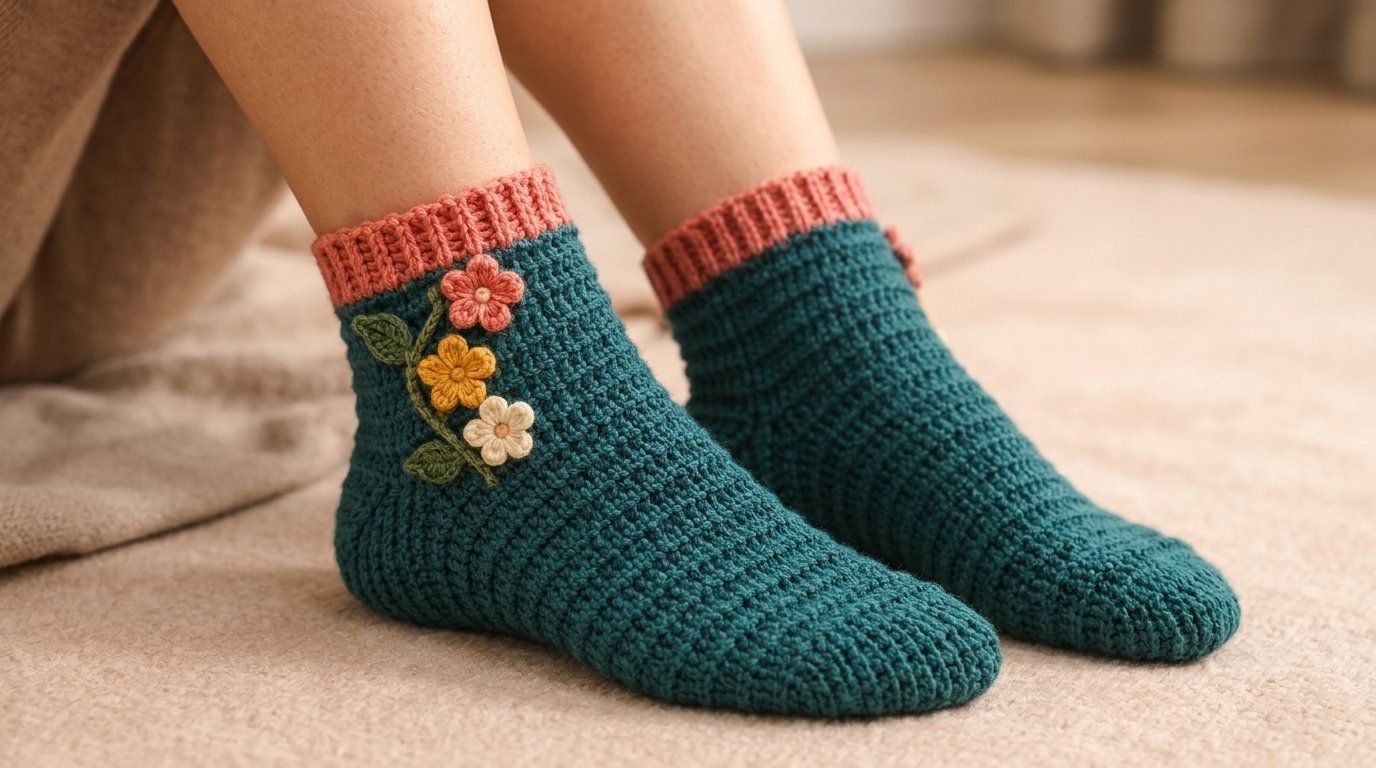
The Meadowline crochet flower socks combine a practical toe-up sock with a small garden-inspired detail at each ankle. The deep teal body uses dense half double crochet for warmth, while the coral ribbed cuff stretches comfortably around the ankle. Three small flowers and two leaves create the raised outer-ankle motif shown in the Pin.
This crochet flower socks pattern is intended for confident beginners who know the basic stitches and are ready to practice simple shaping. You will learn how to increase a rounded toe, create an opening for an afterthought heel, add a stretchy cuff, and assemble a mirrored floral vine for a matching pair.
These are cozy indoor or light-duty house socks. The textured crochet fabric may feel too thick inside close-fitting shoes.
Why You’ll Love This Project
The toe-up construction makes the foot length easy to adjust before the heel opening is formed. The afterthought heel avoids complicated heel-flap calculations, and the separate ribbed cuff gives the ankle opening useful stretch.
The floral decoration is concentrated on the outer ankles instead of covering the entire sock. This keeps the design distinctive without adding bulky appliqués beneath the foot.
Other benefits include:
- Basic stitches and consistent increases
- Three adult sizes
- Adjustable foot length
- Minimal seaming
- Small amounts of contrasting yarn
- Mirrored decorations for a coordinated pair
- A useful handmade gift for cooler weather
Project Overview
- Project type: Adult crochet ankle or house socks
- Difficulty: Confident beginner
- Estimated time: 6–9 hours for a pair
- Sizes: Adult small, medium, and large
- Finished foot circumference: Approximately 7 (8, 9) inches
- Suggested foot length: Approximately 8½ (9¼, 10) inches, adjustable
- Yarn weight: DK/lightweight category 3
- Hook: 3.75 mm, or size needed for gauge
- Main techniques: Half double crochet, increases, decreases, back-loop single crochet, working in continuous rounds, and simple appliqué assembly
- Construction: Toe-up foot, bridged heel opening, afterthought heel, separate ribbed cuff, and sewn floral vine
- Terminology: US crochet terms
All measurements and completion times are estimates. Check the sock against the intended foot while working.
Materials and Supplies Needed
For one pair, gather:
- 260–340 yards of DK-weight yarn in deep teal for the sock bodies
- 30–45 yards of DK-weight coral yarn for the cuffs and flowers
- Approximately 10 yards each of golden mustard, warm ivory, and forest green
- 3.75 mm crochet hook
- 3.5 mm hook for the flowers and leaves, if a firmer appliqué is desired
- Four locking stitch markers
- Yarn needle
- Scissors
- Flexible measuring tape
- Optional small amount of matching sewing thread for reinforcing the appliqués
- Optional sock-blocking forms
A wool-and-nylon or acrylic-and-nylon blend is a practical choice because the nylon improves durability. Avoid yarns with a loose halo, which can obscure the stitch definition and wear quickly beneath the foot.
Choosing the Right Yarn and Hook
Choose a smooth DK-weight yarn with some resilience. A blend containing approximately 20–25 percent nylon is especially useful for socks, though a tightly spun washable wool or acrylic blend can also work for indoor wear.
Cotton yarn has less natural recovery. If you use cotton, choose a blend with elastic fiber or nylon and monitor the ankle opening carefully.
The recommended 3.75 mm hook should create a dense but flexible fabric. If your stitches feel stiff, move up one hook size. If the fabric has large gaps or feels loose, move down a size.
Substituting worsted-weight yarn will make thicker slipper socks and change every finished measurement. Fingering-weight yarn will create a thinner sock but requires additional stitches and a separately calculated gauge.
Crochet Stitches and Abbreviations
- ch — chain: Yarn over and pull the yarn through the loop on the hook.
- sl st — slip stitch: Insert the hook, yarn over, and pull through the stitch and the loop on the hook.
- sc — single crochet: Insert the hook, yarn over and pull up a loop, yarn over, and pull through both loops.
- hdc — half double crochet: Yarn over, insert the hook, yarn over and pull up a loop, yarn over, and pull through all three loops.
- dc — double crochet: Yarn over, insert the hook, yarn over and pull up a loop, then complete the stitch by pulling through two loops twice.
- inc — increase: Work two stitches into the same stitch.
- hdc2tog — half double crochet two together: Yarn over and insert the hook into the next stitch, pull up a loop, repeat in the following stitch, then yarn over and pull through all five loops.
- BLO — back loop only: Work into only the back loop of the indicated stitch.
- st/sts — stitch/stitches
- MR — magic ring
- rep — repeat
- rnd — round
The beginning chain used in the appliqués does not count as a stitch.
Before You Start
Gauge
Work a swatch in half double crochet:
- 16 hdc stitches = 4 inches
- 12 hdc rounds = 4 inches
Measure without stretching. Because socks depend on fit, adjust your hook until the stitch gauge is accurate.
The finished sock should have approximately ½ inch of negative ease around the foot. Choose the size whose finished circumference is slightly smaller than the wearer’s actual foot circumference.
Sizing
Instructions are written for small, with medium and large in parentheses:
- Small: 28 body stitches
- Medium: 32 body stitches
- Large: 36 body stitches
Place a marker in the first stitch and move it upward after every round. The sock body is worked continuously without joining unless directed otherwise.
Make both socks through the cuff before attaching the flowers. This makes it easier to mirror the decorations accurately.
Step-by-Step Crochet Instructions
Crochet the Rounded Toe
Using deep teal:
Rnd 1: Make an MR. Work 7 (8, 9) hdc into the ring. Pull the ring closed. You should have 7 (8, 9) sts.
Rnd 2: Work 2 hdc in every st around. You should have 14 (16, 18) sts.
Rnd 3: Repeat 1 hdc in the next st, 2 hdc in the following st around. You should have 21 (24, 27) sts.
Rnd 4: Repeat 1 hdc in each of the next 2 sts, 2 hdc in the following st around. You should have 28 (32, 36) sts.
The toe should form a shallow, rounded cup. If it is sharply pointed, loosen your starting rounds slightly. If it ripples, check that you have not added extra increases.
Work the Foot
Rnd 5 onward: Work 1 hdc in every st around, maintaining 28 (32, 36) sts.
Continue until the sock measures approximately 6¼ (6¾, 7¼) inches from the center of the toe, or until it reaches the point where the wearer’s heel begins.
For a custom foot length, measure from the tip of the longest toe to the back of the heel. Subtract approximately 2¼ inches. Work the foot tube to that adjusted measurement.
End at the side of the foot. The marker should sit approximately where the outer edge of the foot will be.
Form the Heel Opening
The first half of the stitches becomes the instep. The second half is skipped to create the heel opening.
Heel-opening rnd: Hdc in the next 14 (16, 18) sts. Ch 14 (16, 18), loosely enough to span the skipped section. Skip the remaining 14 (16, 18) sts and continue at the beginning of the next round.
Next rnd: Hdc in each existing instep st and in each chain across the heel bridge. You should again have 28 (32, 36) sts.
Do not work into the skipped stitches yet. They will be used when the heel is added.
Complete the Ankle
Work 5 rounds of hdc, keeping the established 28 (32, 36) stitch count.
Try the sock on carefully. The top edge should sit below or at the ankle bone. Add one or two rounds if a slightly taller ankle is preferred.
Fasten off and weave in the teal end.
Make the Ribbed Cuff
Using coral, ch 9.
Row 1: Sc in the second ch from the hook and in each remaining ch. You should have 8 sc.
Row 2: Ch 1 and turn. Sc BLO in each of the 8 sts.
Repeat Row 2 until the strip has approximately 34 (38, 42) rows and measures about 6¼ (7, 7¾) inches without stretching.
Wrap the strip gently around the ankle opening. Its short ends should meet when the ribbing is lightly stretched. Add or remove two rows if required.
Join the short ends with slip stitches or a neat whipstitch to form a ring. Position the seam at the back of the sock. Stretch the cuff evenly around the ankle opening and sew its lower edge to the final teal round.
The cuff should lie flat without gathering the sock body or feeling restrictive.
Crochet the Afterthought Heel
Rejoin teal yarn at one side of the heel opening.
Heel rnd 1: Work 1 hdc into each skipped body stitch and 1 hdc into the underside of each heel-bridge chain. You should have 28 (32, 36) sts.
Place one marker at each side transition, where the original stitches meet the chain stitches. These markers divide the upper heel from the sole.
For each decrease round, work one hdc2tog immediately before each side marker and another hdc2tog immediately after it. This removes four stitches per round.
Heel rnd 2: Work hdc around, making four decreases as described. You should have 24 (28, 32) sts.
Heel rnd 3: Repeat the decrease placement. You should have 20 (24, 28) sts.
Heel rnd 4: Repeat. You should have 16 (20, 24) sts.
Heel rnd 5: Repeat. You should have 12 (16, 20) sts.
Fasten off with a long tail. Turn the sock inside out, flatten the remaining heel opening so the decreases sit at the sides, and whipstitch the final 6 (8, 10) stitch pairs together. Weave in the end securely.
Make the Flowers
Make six flowers: two coral, two mustard, and two warm ivory.
With the 3.5 mm hook, make an MR.
Repeat the following petal five times inside the ring:
Ch 2, work 2 hdc into the ring, ch 2, sl st into the ring.
Pull the center closed after the fifth petal. Fasten off with a tail long enough for sewing.
Each sock receives one flower in each color.
Make the Leaves
Make four forest-green leaves.
Ch 6.
- Sl st in the second ch from the hook.
- Sc in the next ch.
- Hdc in the next ch.
- Dc in the next ch.
- Work 5 dc in the final ch to turn around the tip.
- Continuing along the underside of the foundation chain, work dc, hdc, sc, and sl st in the corresponding chains.
Fasten off with a sewing tail.
Make the Curved Stems
Make two forest-green stems.
Ch 16. Beginning in the second ch from the hook, sl st in every ch across. Fasten off with a long sewing tail.
The finished cord should be flexible enough to curve along the outer ankle.
Repeat for the Second Sock
Make a second sock using the same size and construction. Before attaching decorations, place the socks side by side with both toes pointing forward. Mark the outer ankle of each sock so the floral arrangements will mirror each other.
Assembly and Finishing
Pin one green stem in a gentle curve along the outer ankle of the first sock. Keep it above the heel and away from the sole. Sew through the sock fabric without pulling so tightly that the ankle loses its stretch.
Arrange the flowers vertically:
- Coral flower near the upper stem
- Mustard flower near the center
- Ivory flower near the lower end
Sew around each flower center and add a few small anchoring stitches beneath the petals. Attach two leaves on opposite sides of the stem.
Mirror the same arrangement on the second sock. Check that both motifs face outward when the socks are worn.
Weave in every end on the wrong side. Lightly dampen and shape the socks by hand. Allow them to dry flat.
Tips for Best Results
- Count the body stitches every few rounds. One accidental increase can noticeably change the fit.
- Keep the heel-opening chains loose enough to match the width of the skipped stitches.
- Use locking markers at both sides of the heel so all decreases remain aligned.
- Complete both undecorated socks before sewing on the appliqués.
- Keep the flower stitches firm so the petals hold their shape.
- Use small, flexible sewing stitches when attaching the vine.
- Try the sock on before adding the cuff and before closing the heel seam.
- Keep all decorations above the shoe line if the socks may be worn with loose boots.
Common Mistakes and Troubleshooting
The sock is too tight
Check the stitch gauge first. If the gauge is correct but the sock is still tight, use the next size while retaining the desired foot length. Do not simply stretch the heel chains aggressively, since that can distort the ankle.
The toe looks pointed
The starting rounds may be too tight. Remake the magic ring with relaxed tension or use a hook one size larger for the first two rounds.
The heel has holes at the sides
Small gaps can appear where yarn is joined around the opening. Pick up one extra loop at each corner during Heel Round 1, then decrease those two extra stitches in the following round.
The cuff flares outward
The ribbed strip is too long. Remove several rows, rejoin the short ends, and sew it back in place with gentle, even stretching.
The ankle puckers beneath the flowers
The appliqués were sewn too tightly. Remove the tight stitches and reattach the pieces while the sock is lightly stretched over your hand or a sock form.
The two socks are different lengths
Count body rounds and cuff rows rather than relying only on visual comparison. Place the socks flat together before starting the second heel.
Creative Variations
Replace the teal body with denim blue, burgundy, or rich lavender while retaining high contrast between the sock and flowers.
For a quieter design, use three shades from the same color family. For a bolder garden effect, make each flower a different saturated color while keeping the leaves and stem consistent.
You can also:
- Use one larger flower instead of three small flowers
- Add one extra ankle round for a taller fit
- Replace the vine with a short straight stem
- Make the cuff and flowers in the same color
- Omit the appliqués for plain ribbed ankle socks
- Add small French knots to the flower centers
Avoid placing beads, buttons, or raised decorations near the sole, heel, or inner ankle.
How to Use or Style Your Crochet Socks
These flower socks work well as cozy house socks, travel socks, or a handmade addition to a winter gift basket. The colorful ankle motif looks especially attractive with cuffed lounge pants, leggings, or pajamas.
Because crochet creates a thicker fabric than many commercial socks, wear them with roomy slippers or loose boots rather than snug shoes. They are not intended as athletic socks, outdoor hiking socks, or protective footwear.
For smoother floors, consider applying a purpose-made flexible nonslip treatment to the soles according to its instructions.
Care and Maintenance
Follow the care directions on the yarn label. When uncertain, hand-wash the socks in cool water with a mild detergent.
Press out excess water without twisting. Reshape the toe, heel, cuff, and flower petals, then dry the socks flat. Avoid hanging them while wet because the weight can stretch the ankle and foot.
Store the pair flat or loosely folded. Do not pull the flowers when removing the socks. If a petal or leaf loosens, reinforce it with matching yarn before wearing the socks again.
Frequently Asked Questions
Can a complete beginner make these socks?
A beginner who can work half double crochet in continuous rounds can follow the main body. The heel shaping and mirrored floral assembly make this most suitable for a confident beginner.
Can I use worsted-weight yarn?
Not with the listed stitch counts and measurements. Worsted yarn produces a much larger, thicker sock. A new gauge and stitch calculation would be necessary.
How do I adjust the foot length?
Work more or fewer plain foot rounds before forming the heel opening. Stop when the toe-to-opening measurement equals the desired finished foot length minus approximately 2¼ inches.
Can I make the socks wider without making them longer?
Yes. Select the next circumference size and work the foot only to the required length before forming the heel opening.
Why is the cuff made separately?
Back-loop single crochet creates flexible vertical ribs when worked as a strip. Making the cuff separately also allows its circumference to be checked before attachment.
Can I wear these socks inside shoes?
They may fit roomy slippers or boots, but the crochet texture and flower appliqués are likely to feel bulky in close-fitting shoes.
Do the flowers need to be identical?
Use the same number of petals and approximately the same tension, but small handmade variations will not affect the socks’ structure.
Can I omit the flowers?
Yes. The sock construction is complete without the decorative vine. You can leave the cuff plain or add simple surface embroidery instead.
Conclusion
The Meadowline crochet flower socks pair approachable toe-up construction with a cheerful, concentrated floral detail. The adjustable foot, simple afterthought heel, and separate ribbed cuff make the pattern easy to personalize for different adult sizes.
Choose your favorite garden colors, mirror the vines on the outer ankles, and enjoy creating a cozy pair with plenty of handmade character.
Related Crochet Projects
- Ribbed crochet slipper boots with a folded cuff
- Coordinating flower-appliqué wrist warmers
- A small crochet sleep mask with matching floral details
- Beginner toe-up socks with striped cuffs