Cedar Line Crochet Table Runner Pattern
The Cedar Line Table Runner combines a richly textured denim-blue center with narrow ivory and coral bands near both ends. A simple ivory border...
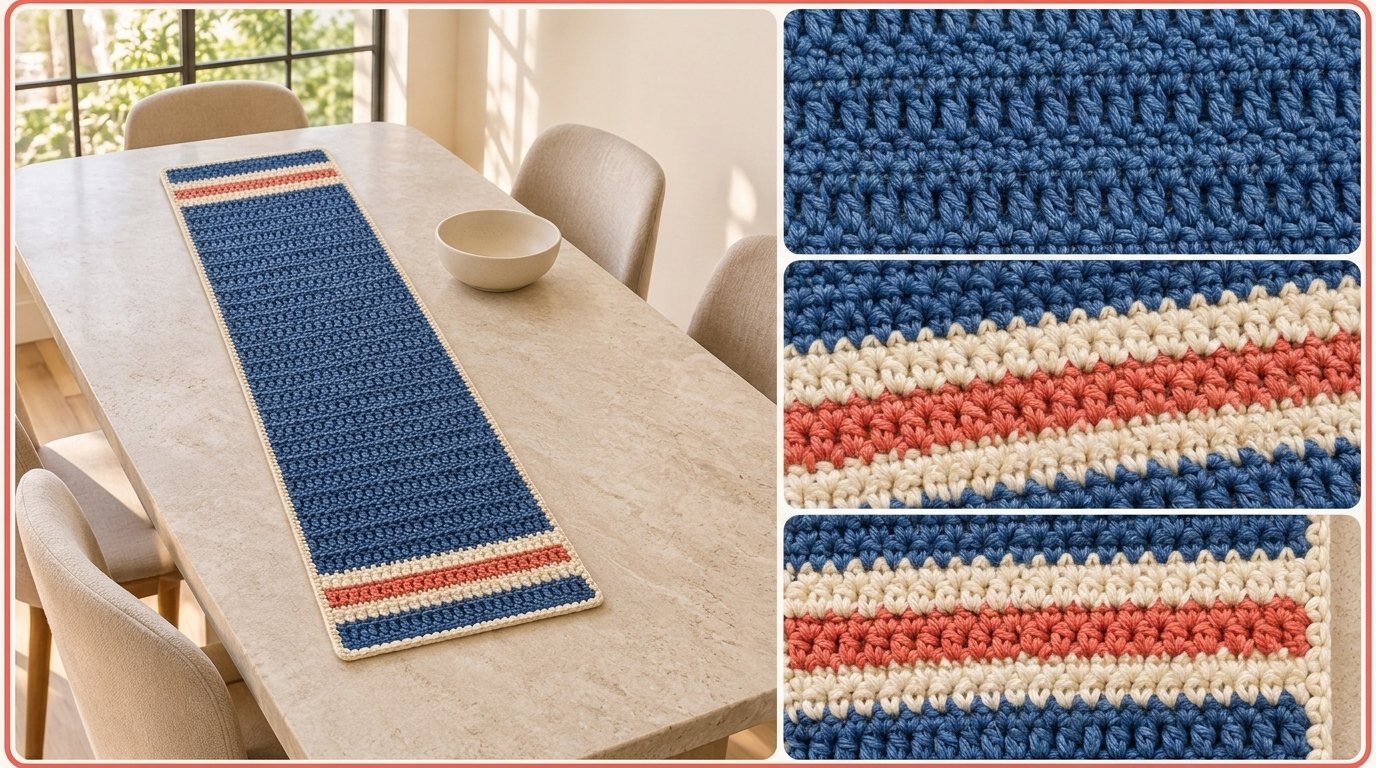
The Cedar Line Table Runner combines a richly textured denim-blue center with narrow ivory and coral bands near both ends. A simple ivory border frames the rectangular shape without fringe, tassels, or complicated finishing.
This crochet table runner pattern uses alternating single and double crochet stitches to produce a dense, subtly pebbled surface. The same one-row repeat continues throughout the project, making the design accessible to beginners who are comfortable maintaining a consistent stitch count.
The finished runner is approximately 14½ inches wide and 49 inches long. Its dimensions can be adjusted for a dining table, console, coffee table, or sideboard.
Why You’ll Love This Project
The main texture uses only single and double crochet. Because every row repeats the same sequence, you can settle into a steady rhythm after completing the foundation.
The colored bands create visual interest without requiring complex colorwork. Each stripe is worked across a complete row, so there is no need to carry multiple colors within the fabric.
Cotton yarn gives the runner useful structure and clear stitch definition. The border tidies the row ends and helps the finished rectangle lie flat.
Project Overview
- Project type: Textured rectangular table runner
- Difficulty: Beginner
- Estimated time: 12–16 hours
- Estimated finished size: 14½ by 49 inches
- Yarn weight: Medium weight number 4
- Hook: US H/8, 5 mm
- Main techniques: Single crochet, double crochet, row-end color changes, and border crochet
- Construction: One flat rectangle worked from short end to short end
- Terminology: US crochet terms
Time, dimensions, and yarn quantities are estimates. Your tension and materials may produce a different result.
Materials and Supplies Needed
- Approximately 750 yards denim-blue medium-weight cotton yarn
- Approximately 175 yards warm-ivory medium-weight cotton yarn
- Approximately 60 yards coral medium-weight cotton yarn
- US H/8, 5 mm crochet hook
- Two stitch markers
- Yarn needle
- Scissors
- Measuring tape
- Blocking mats or clean towels
- Rust-resistant blocking pins, optional
Use yarns with the same weight and similar fiber content so the stripes remain even.
Choosing the Right Yarn and Hook
Smooth cotton or a cotton-acrylic blend is recommended. Cotton creates a structured runner with crisp edges, while a blended yarn can reduce the overall weight and drying time.
Acrylic yarn may also be used for decorative purposes, but it should not come into contact with hot serving dishes. Regardless of fiber, always place an appropriate heat-resistant trivet beneath hot cookware.
The suggested 5 mm hook creates fabric that is dense without feeling rigid. Move up one hook size if the runner curls or feels difficult to work. Move down one size if the fabric appears loose and open.
Suggested Gauge
Approximately 15 stitches and 13 rows equal 4 inches in the alternating stitch pattern.
A foundation of 54 stitches should measure approximately 14½ inches wide. The complete 160-row body should measure close to 49 inches long.
Crochet Stitches and Abbreviations
- ch — chain: Yarn over and pull the yarn through the loop on the hook.
- sc — single crochet: Insert the hook, yarn over, and pull up a loop. Yarn over and pull through both loops.
- dc — double crochet: Yarn over, insert the hook, yarn over, and pull up a loop. Yarn over and pull through two loops twice.
- sl st — slip stitch: Insert the hook, yarn over, and pull through the stitch and the loop on the hook.
- st — stitch
- sts — stitches
- RS — right side
- WS — wrong side
- rep — repeat
The turning chain does not count as a stitch. Work the first stitch into the first stitch of the previous row.
Alternating Texture Stitch
Work sc in the next st, dc in the next st across an even number of stitches.
Repeating the same sequence after turning places each single crochet into a previous double crochet and each double crochet into a previous single crochet. This creates the textured surface.
Before You Start
Make a gauge swatch at least 6 inches square. Wash and dry it according to the yarn label before measuring the center four inches.
Place a stitch marker in the first and last stitch of each row if you have difficulty identifying the edges. Every row must contain 54 stitches.
Complete color changes during the final yarn-over of the last double crochet in the row before the new color begins. Cut the previous color, leaving a 5-inch tail for weaving.
The runner is symmetrical. The stripe sequence used near the beginning is repeated in reverse order near the opposite end.
Step-by-Step Crochet Instructions
Foundation and First Denim Section
With denim blue, ch 55.
Row 1: Sc in the second ch from the hook, dc in the next ch. Repeat sc in the next ch, dc in the next ch across. Turn. You should have 54 sts.
Rows 2–20: Ch 1, sc in the first st, dc in the next st. Repeat sc in the next st, dc in the next st across. Turn.
Maintain 54 sts in every row.
First Ivory Band
Change to warm ivory in the final yarn-over of Row 20.
Rows 21–24: Repeat the established alternating texture stitch across each row.
Fasten off ivory after Row 24.
Coral Accent Band
Join coral during the final yarn-over of the last stitch in Row 24.
Rows 25–28: Repeat the alternating texture stitch across each row.
Fasten off coral after Row 28.
Second Ivory Band
Join warm ivory at the end of Row 28.
Rows 29–32: Repeat the alternating texture stitch.
Fasten off ivory after Row 32.
You should now have an ivory-coral-ivory stripe sequence near the first short end.
Long Denim Center
Join denim blue at the end of Row 32.
Rows 33–128: Repeat the alternating texture stitch across every row.
Check the width and stitch count periodically. The long center section should remain rectangular, with 54 sts in every row.
Repeat the End Bands
Change to warm ivory at the end of Row 128.
Rows 129–132: Work the alternating texture stitch in warm ivory.
Change to coral.
Rows 133–136: Work the alternating texture stitch in coral.
Change to warm ivory.
Rows 137–140: Work the alternating texture stitch in warm ivory.
The second stripe sequence should now match the first.
Complete the Final Denim Section
Change to denim blue at the end of Row 140.
Rows 141–160: Repeat the alternating texture stitch.
Fasten off denim blue and weave in the color-change tails before adding the border.
Check the Rectangle
Lay the runner flat without stretching it. Confirm that:
- Both short denim sections contain 20 rows.
- Each ivory band contains four rows.
- Each coral band contains four rows.
- The center denim section contains 96 rows.
- Every row contains 54 stitches.
A small difference in length can usually be corrected during blocking.
Add the Ivory Border
Join warm ivory in any corner.
Border round: Ch 1 and work (sc, ch 2, sc) in the corner.
Work 1 sc in every stitch across each short edge. At the next corner, work (sc, ch 2, sc).
Along each long edge, work 1 sc in every row end. Add an extra sc approximately every sixth row end so the border follows the fabric without pulling.
Continue around the runner, working (sc, ch 2, sc) in every corner. Join with a sl st to the first sc.
Before fastening off, lay the runner flat:
- If the border ripples, remove a few side stitches.
- If the edge pulls inward, add a few more stitches.
- If the corners curl, add one additional sc inside each corner space.
Fasten off and weave in the final tail.
Adjusting the Width
The stitch pattern requires an even number of stitches.
To change the width, make any odd-numbered starting chain. Working into the second chain from the hook will leave an even number of stitches.
Make a gauge swatch and multiply your stitches per inch by the desired width. Round the result to the nearest even number.
Adjusting the Length
Add or remove rows from the long central denim section. Keep the first and final 32-row decorative sections unchanged if you want the bands to remain symmetrical.
At the suggested row gauge, approximately 13 rows add 4 inches of length.
Assembly and Finishing
This runner has no separate pieces to assemble. Finishing consists of securing the yarn ends, checking the border, and blocking the rectangle.
Thread each tail onto a yarn needle and weave it through several stitches of the matching color. Change direction once before trimming the excess.
Wet-block or steam-block according to the yarn label:
- Wash or dampen the runner.
- Remove excess water without twisting.
- Lay it flat on blocking mats or clean towels.
- Straighten the long edges.
- Measure the width at several points.
- Adjust the corners to form right angles.
- Allow the runner to dry completely.
Do not apply a hot iron directly to the crochet fabric.
Tips for Best Results
Count 54 stitches every few rows. Correcting a missed edge stitch promptly is easier than rebuilding a long tapered section.
Keep the turning chain loose so the side edges do not tighten.
Change colors during the final yarn-over of the row. This produces a cleaner transition than joining after turning.
Use separate yarn pieces instead of carrying unused colors along the edge. The long gaps between stripe sections would make carried strands bulky and visible.
When working the border, spread the runner flat after completing each side. Adjust the stitch spacing before continuing.
Common Mistakes and Troubleshooting
The runner becomes narrower
The final stitch of one or more rows was probably missed. Use markers to identify both edge stitches and maintain 54 sts.
The texture looks like vertical columns
Check the turning direction and stitch placement. Each sc should be worked into a dc from the previous row, and each dc should be worked into an sc.
The long edges wave
The border contains too many stitches. Remove it and reduce the number of extra sc placed along the row ends.
The border pulls inward
Add more stitches along the long edges or use a hook one size larger for the border.
The color bands do not align
Confirm the number of rows in each section. Both ends should follow the same 20-blue, 4-ivory, 4-coral, and 4-ivory arrangement.
The runner curls
Curling may result from tight tension, a tight foundation chain, or an undersized hook. Blocking can correct mild curling.
Creative Variations
Replace denim blue with forest green and use cream and burgundy bands for winter table décor.
For a warmer look, combine rust, golden mustard, and natural cotton white. A black, camel, and ivory palette creates a more graphic contemporary style.
Work the entire runner in one color if you prefer uninterrupted texture. The striped row counts can simply become part of the main fabric.
Add a second border round for a wider frame. Work one sc in every stitch and (sc, ch 2, sc) in each corner space.
Avoid tassels if the runner will be used frequently at a dining table, where loose decorations may interfere with chairs or table settings.
How to Use or Style Your Crochet Project
Center the runner lengthwise on a dining table, allowing the short ends to stop before the table edge or hang slightly over it.
On a console or sideboard, use it beneath a low decorative bowl, framed photograph, or battery-operated candle. Avoid placing an open flame directly on crochet fabric.
The denim and coral palette works well with cream dishes, warm wood, pale stone, matte ceramics, and brushed brass accents.
For everyday use, leave the center relatively open so the stitch texture and symmetrical bands remain visible.
Care and Maintenance
Follow the washing instructions on the yarn label. Cotton runners are often washable, but the recommended water temperature and drying method vary by yarn.
Hand washing or a gentle machine cycle can help preserve straight edges. Place the runner in a mesh laundry bag if machine washing is permitted.
Reshape while damp and dry flat. Hanging a wet runner may stretch it lengthwise.
Store the runner clean, completely dry, and loosely rolled rather than sharply folded. Rolling helps prevent permanent creases across the textured fabric.
Use trivets or heat-resistant pads beneath hot cookware and serving dishes.
Frequently Asked Questions
Is this table runner suitable for beginners?
Yes. It uses basic single and double crochet stitches in a one-row repeat. The main challenge is maintaining the stitch count over a long project.
Can I use acrylic yarn?
Yes, but acrylic is less suitable around heat. Always use heat-resistant protection beneath warm or hot serving items.
How can I make the runner shorter?
Remove rows from the long denim center. Keep both striped end sections identical.
Can I make matching placemats?
Yes. Use the same stitch pattern and color sequence with fewer foundation stitches and a shorter central section.
Why must the stitch count be even?
The alternating pattern uses pairs of stitches: one single crochet followed by one double crochet.
Does the runner require blocking?
Blocking is strongly recommended. It improves the rectangular shape, straightens the border, and helps both stripe sections lie evenly.
Can I omit the border?
Yes, but the border conceals row-end irregularities and emphasizes the rectangular shape.
How much yarn will a longer runner require?
Yarn usage increases with every added row. Weigh the completed central section or track the amount used over a measured number of rows to estimate additional yarn.
Conclusion
The Cedar Line Table Runner turns a simple stitch sequence into structured, modern home décor. Its denim-blue texture, symmetrical coral bands, and clean ivory frame provide visual interest without complicated crochet techniques.
Adjust the length, select colors that suit your room, and use the same construction to create coordinating runners or placemats.
Related Crochet Projects
- Textured cotton placemats
- Color-block console-table mat
- Coordinating crochet napkin rings
- Modern striped cushion cover